


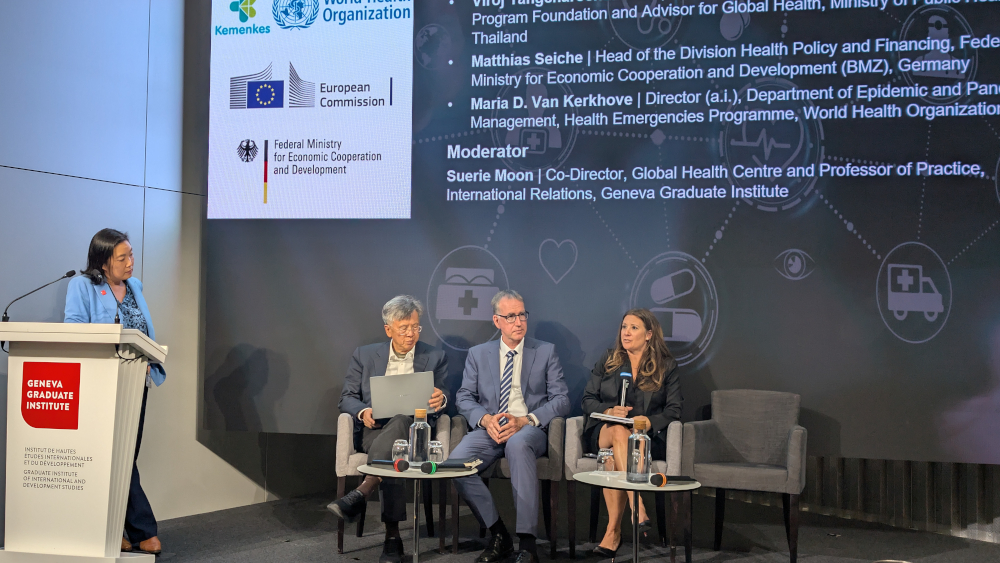
WHO emergency funds are running low, and global health leaders are concerned about a systemic paralysis in pandemic preparedness. In high-level discussions in Geneva, experts explored the geopolitical rifts, pitting the Global South’s demand to treat pandemic tools as legally binding “public goods” against a European push for market-driven surge financing.
As a severe Ebola outbreak spreads among vulnerable populations in the Democratic Republic of the Congo and Uganda, the financial gridlock in global pandemic preparedness funding is taking a measurable human toll. The escalating emergency serves as a grim reminder that “nature does not wait for humans to finish treaty negotiations,” Professor Suerie Moon, co-director of the Global Health Centre (GHC) at the Geneva Graduate Institute, noted at a high-level forum in Geneva.
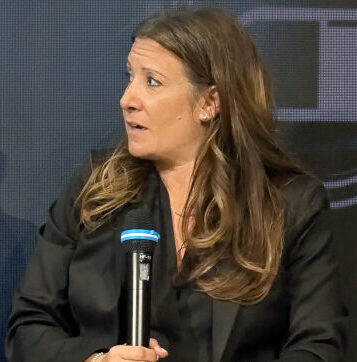
Public health leaders warned at the event that the threat from infectious diseases and pandemic preparedness are severely neglected while nations simultaneously ramp up military defence and border security spending.
Expressing her frustration over these skewed global priorities, Dr Maria Van Kerkhove, acting director of the department of epidemic and pandemic management at the World Health Organization (WHO), noted that the agency’s contingency fund for emergencies is “dangerously low right now.”
“You can spend billions of dollars a day on a war, and we don’t have money for this,” she stated, calling the constant struggle for health financing “ridiculous” during the panel discussions.
Co-hosted by the GHC, the WHO, the European Commission, and the governments of Indonesia and Germany, the forum convened a diverse coalition of decision-makers.
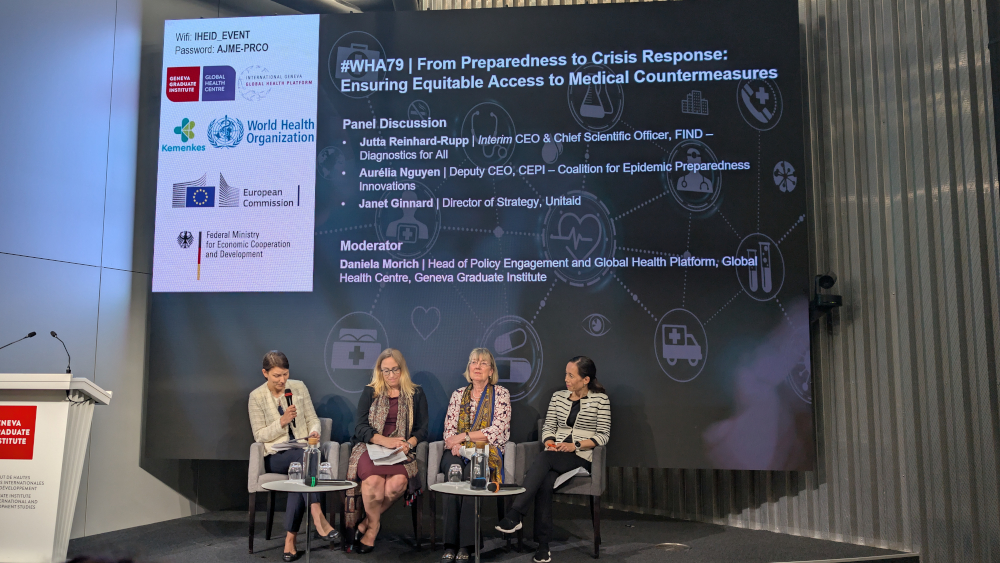
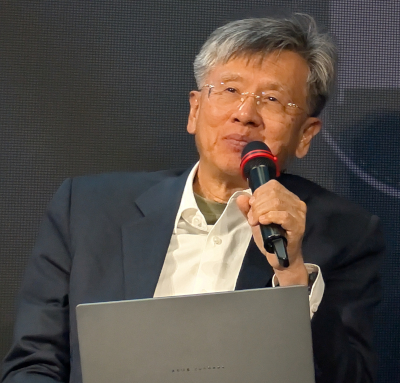
Alongside Van Kerkhove, Dr Viroj Tangcharoensathien, vice-chair of the Intergovernmental Working Group (IGWG) on the WHO Pandemic Agreement, and Matthias Seiche, head of health policy and financing at Germany’s Federal Ministry for Economic Cooperation and Development, offered contrasting visions over approaches to crisis funding. They were followed by a technical panel of specialised agencies that explored practical implementation, moderated by GHC’s Head of Policy Engagement, Daniela Morich.
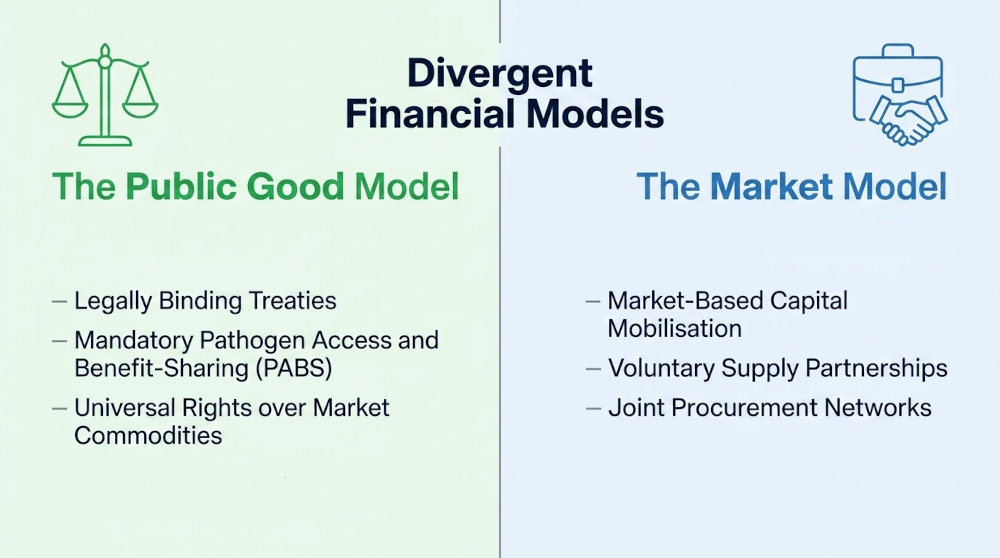
The debate exposed a deep ideological rift: while low- and middle-income countries are demanding legally binding treaties that mandate equitable access to life-saving tools as a universal public good, western states are pushing for market-based financial mechanisms to quickly mobilise capital in the event of a crisis.
Championing pandemic preparedness as a ‘public good’
For the Global South, the solution to this systemic paralysis lies not in ad-hoc charity or voluntary donations, but in strict, enforceable obligations under Article 12 of the WHO Pandemic Agreement. This article establishes the pathogen access and benefit-sharing (PABS) system, the details of which are still being negotiated by the IGWG.
Low- and middle-income nations argue that if they share biological materials with the international community, pharmaceutical companies must be legally compelled to share the resulting vaccines, therapeutics, and diagnostics.
Reinforcing this demand, Tangcharoensathien warned the forum that current voluntary and interim mechanisms are vastly inadequate for pandemic preparedness and major crises. He urged the rapid adoption of the PABS annex to regulate how outbreak-prone pathogens and their genetic sequences are shared globally.
To operationalise this, the African Group and the Group for Equity – representing over 80 countries and roughly 75% of the global population – are pushing for standardised contracts that commercial users must sign before accessing any pathogen materials or sequence information.
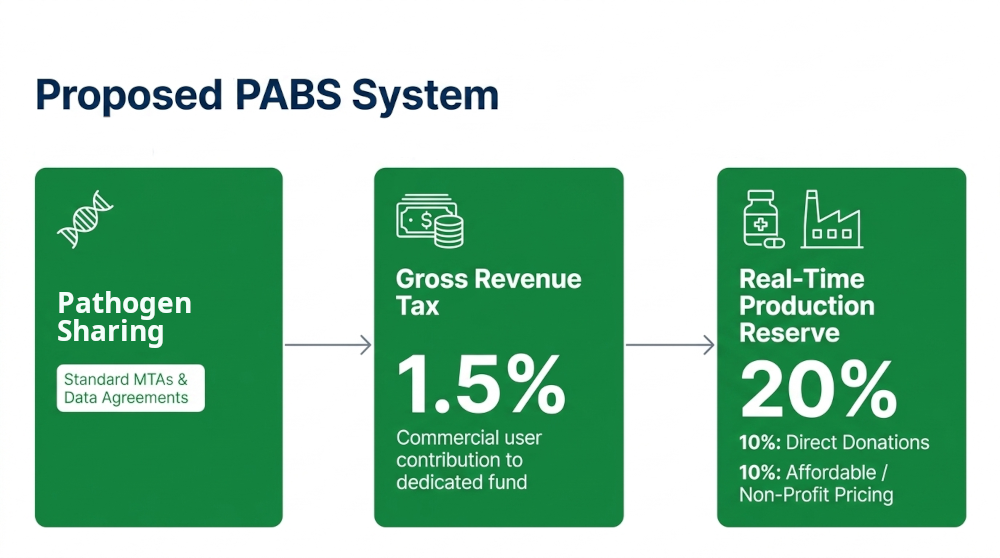
Under these proposed agreements, which include Standard Material Transfer Agreements (SMTAs) and Data Access Agreements, commercial users generating revenue from PABS materials would be required to contribute up to 1.5% of their gross revenue to a dedicated fund.
Participating manufacturers would also be legally bound to reserve at least 20% of their real-time production for the WHO during a pandemic, providing a minimum of 10% as donations and the remainder at affordable or not-for-profit prices.
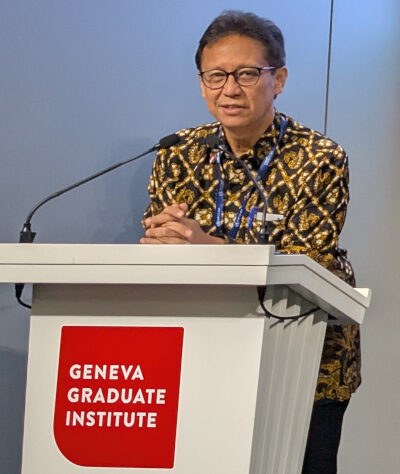
Reflecting the urgency of treating these tools as universal rights rather than market commodities, Indonesian Minister of Health Budi Gunadi Sadikin – a likely contender for the post of WHO director-general in the upcoming elections – made a stark plea to the forum. “During crises, we need to make this a public good… You cannot play God through this,” he stated in his keynote speech.
Global health funding agencies on the panel strongly supported the demand for legal accountability.
“At the end of the day, until you have something in a contract, you don’t have access,” said Aurélia Nguyen, deputy CEO of the Coalition for Epidemic Preparedness Innovations (CEPI).
Pointing to the urgent need for legally binding agreements, Nguyen noted that funders must act immediately: “We need to be doing that one by one and making sure those access provisions are built in.”
Europe’s ‘global good’ paradox
The contentious debate on pandemic preparedness is playing out against a broader backdrop of rising geopolitical friction and transactionalism in global health policy, Dr Florika Fink-Hooijer, director-general of the European Commission’s Health Emergency Preparedness and Response Authority (DG HERA), pointed out in her keynote remarks.
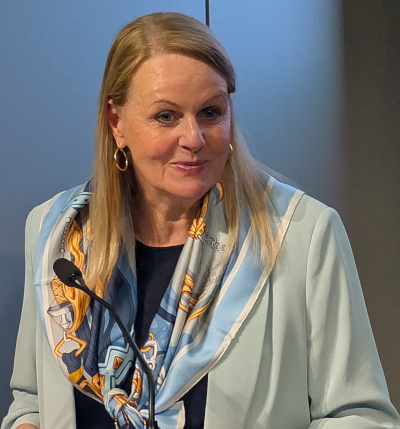
“We are in a very difficult context,” she warned the forum. “Health has really become transactional.
“Health is something which is a geopolitical instrument. It’s certainly not necessarily treated as a global good, and that we have to bring back,” she urged.
Despite Fink-Hooijer’s appeal for a return to treating health as a global good, the European Union’s approach in practice relies heavily on voluntary partnerships and leveraging a strong private sector.
Fink-Hooijer noted that Europe is investing in mechanisms like joint procurement networks and private-public partnerships to ensure the continent remains “reliable” as a global partner during emergencies.
Recently published official EU policy emphasises that a competitive European health industry is a core pillar of global health resilience.
Reliance on private investments
Diverging significantly from the strict, legally binding mandates for corporations demanded by the Global South, high-income blocs – including EU member states, Switzerland, and Norway – are pushing to retain anonymous access to pathogen genetic sequence databases.
To accommodate this, an informal “hybrid model” has recently been floated for the PABS system, which includes an “open route” that would allow commercial users to access data without signing binding contracts.
This proposal has been sharply criticised by policy experts at the South Centre and a coalition of over 100 non-governmental organisations, including Oxfam and Medicus Mundi International.
However, Europe’s reliance on the private sector extends to pandemic funding, and European representatives warned that idealistic labels do not magically solve the financial realities of crisis response.
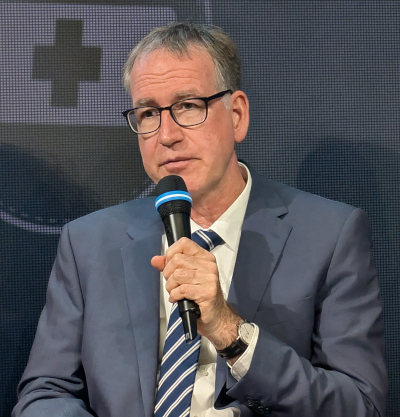
Arguing for models that leverage institutional capital, Germany’s senior diplomat Matthias Seiche cautioned the Geneva panel that whether pandemic funding is framed as Official Development Assistance (ODA) or a global public good, it inherently relies on domestic contributions.
“In the end, it is always the taxpayers’ money that has to be combined from countries all over the world,” he said.
Germany champions limited ‘surge financing’
To circumvent the delays of traditional voluntary funding – and provide a market-driven alternative to the mandatory corporate contributions demanded by the Global South – industrialised nations are instead championing the Global Surge Financing Initiative.
First established in 2024 through a memorandum of understanding signed by development finance institutions from G7 nations, the European Investment Bank (EIB), MedAccess, and the World Bank’s International Finance Corporation (IFC), this mechanism aims at pooling institutional capital to rapidly finance advance purchase agreements for lower-income countries.
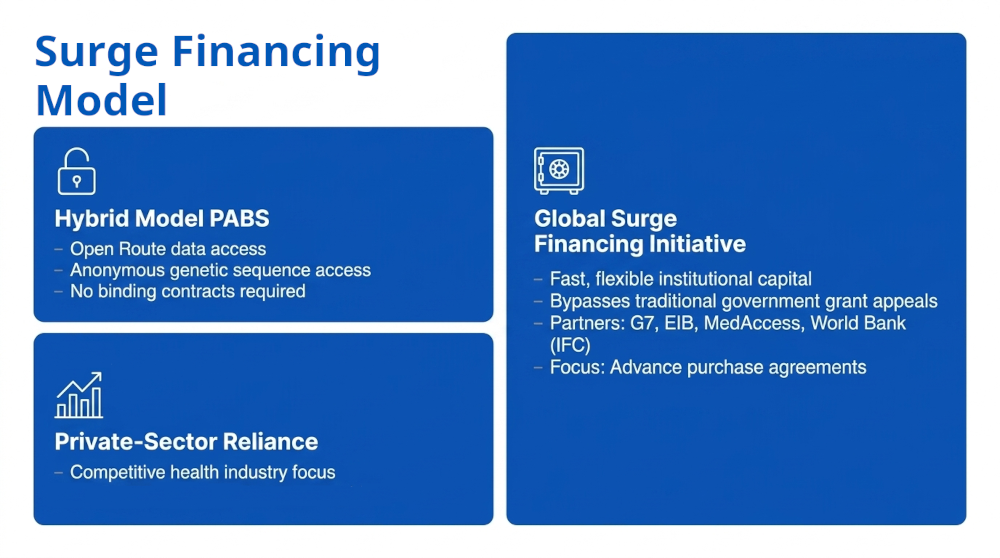
Providing “fast and flexible capital” – as the initiative’s partners describe it – through this balance sheet approach would bypass the need to appeal to government finance ministers for grants during the crucial early surge of an outbreak.
Seiche noted that Germany is “in very close and concrete discussions together with the World Bank on putting into place a mechanism to mobilise surge financing at a very large and substantial scale.”
However, fellow panellist Tangcharoensathien expressed scepticism about the initiative. Doubting whether the scale-up mechanism could mobilise adequate support, he argued instead for a sustainable and systematic funding mechanism anchored in the Pandemic Agreement.
Furthermore, he cautioned that because regular monetary contributions under the proposed treaty might ultimately be too small to cover massive emergencies, domestic funding remains the key response.
Acknowledging this limitation, Seiche conceded that while the World Bank mechanism has great potential for the initial weeks of a crisis, longer-term responses will still rely heavily on traditional grant funding.
The ‘scrappy’ interim reality
Despite the stark contrast in approaches having led to a deadlock in negotiations on pandemic preparedness, global health expert Moon is “actually optimistic” and “confident” that negotiators will successfully reach a consensus.
Echoing this sentiment, Van Kerkhove agreed that she is “very hopeful” and “confident it will be finished.” Yet, underscoring that the world cannot wait for these highly complex and contested formal negotiations to conclude, she noted that the WHO and its partners are heavily relying on “scrappy” interim frameworks like the Medical Countermeasures Network.
“We don’t want to get ahead of member states, but we need something that’s in place,” she stated. Noting the urgency of the Ebola response, she added: “But … we can’t wait until it’s done. So that’s why we have these interim mechanisms.”
However, with the WHO’s emergency contingency funds critically depleted, the ultimate test remains one of global priorities. As long as the international community remains willing to fund defence spending effortlessly while leaving pandemic preparedness and health crisis mechanisms drained, the world will remain dangerously exposed to the next pandemic threat.
Member States Support Extending Talks on Pandemic Agreement Annex, Propose New ‘Method’
Image Credits: Felix Sassmannshausen/HPW.
Combat the infodemic in health information and support health policy reporting from the global South. Our growing network of journalists in Africa, Asia, Geneva and New York connect the dots between regional realities and the big global debates, with evidence-based, open access news and analysis. To make a personal or organisational contribution click here.
Analysis,Content type,Drug & Diagnostics Development,Emergency Response,European Union,Global Health Centre – Graduate Institute,Infectious Diseases,Institutions,Intellectual Property,News,NGOs,Pandemic Agreement,Pandemic Preparedness,Pandemics & Emergencies,Research Institutes,The South Centre,Uncategorized,Crisis Financing,Ebola outbreak,Medical Countermeasures,PABS,pandemic preparedness,pathogen access and benefit sharing,Surge Financing,WHO Pandemic Agreement#Mandates #Markets #Geopolitical #Rift #Impairs #Pandemic #Preparedness #Crisis #Funds #Hit #Dangerous #Lows1779811593
