


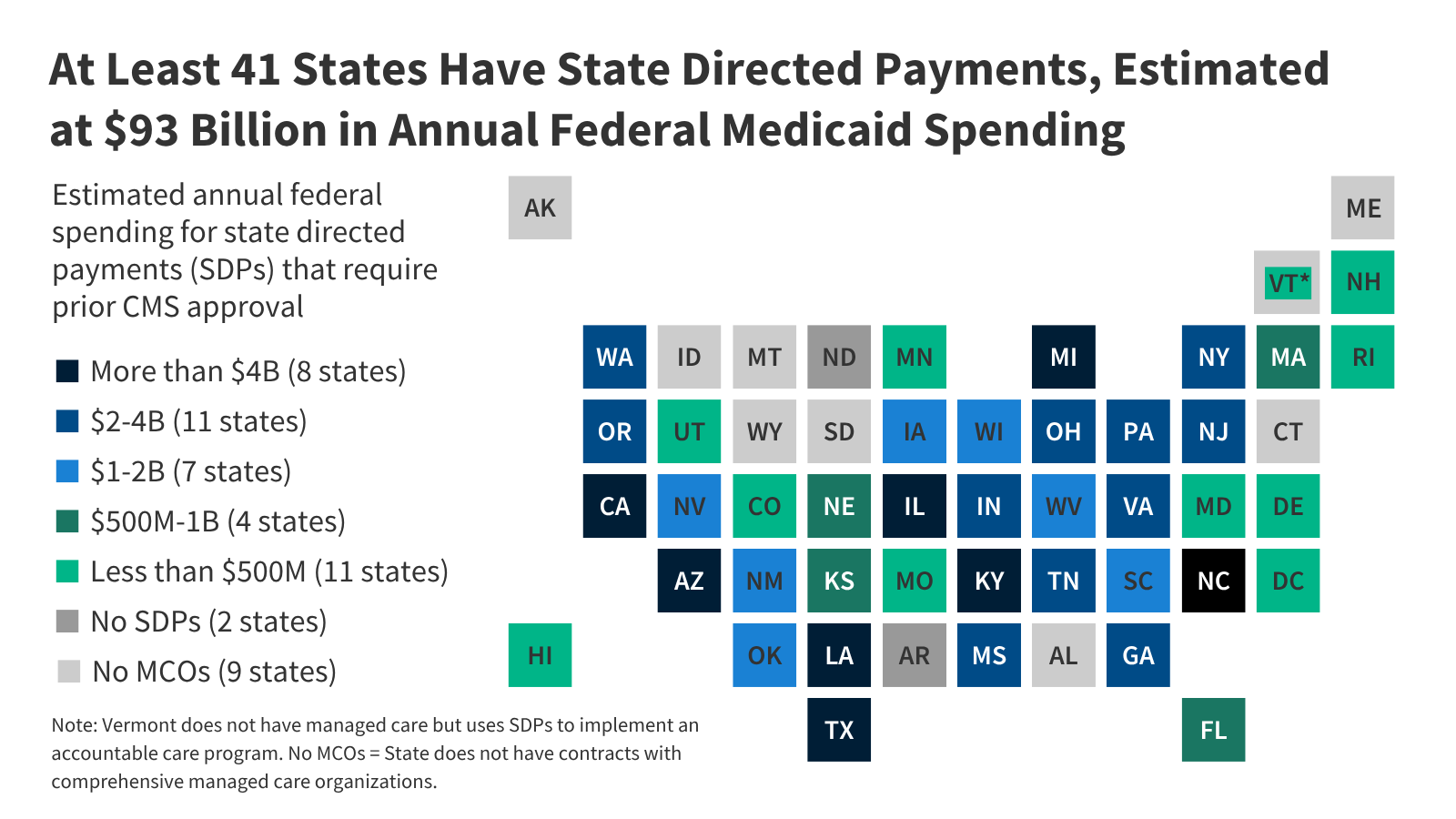
Forty states and DC currently receive $93 billion in annual federal Medicaid spending through state directed payments (SDPs) and may be at risk due to forthcoming limits on these payments, according to new KFF estimates. Annual federal spending on SDPs is highest in California (an estimated $10.6 billion)—followed by Texas ($6.3 billion), North Carolina ($5.2 billion), and Illinois ($5.1 billion).
The vast majority of federal SDP spending (84%) covers hospital services, totaling an estimated $78 billion annually. Professional services at academic medical centers ($3.2 billion) and nursing facility services ($2.1 billion) account for the next-largest shares of federal SDP spending each year.
First established in 2016, SDPs allow states to direct how managed care organizations pay for services. They may take a variety of forms but most commonly require the managed care organization to make supplemental payments and specify a total payment rate. KFF estimates that 84% of SDP spending is currently benchmarked to commercial (or private) rates, which are notably higher than Medicare rates.
CMS started approving SDPs that linked payments to commercial rates in 2018 because the higher rates were seen as helpful to attracting a broader provider network and ensuring robust access to care. In 2024, a rule on Medicaid managed care codified the payment limit for SDPs at average commercial rates but also spurred additional spending on them as states began pegging more SDPs to the average commercial rates.
Just over a year later, the 2025 reconciliation law established new limits on SDPs, capping payment rates at or near Medicare levels instead of average commercial rates. These new limits will reduce payment rates for Medicaid services in affected states, with the largest effects expected to be on hospitals since they account for the majority of SDP spending. In May, the Centers for Medicare and Medicaid Services (CMS) issued a proposed rule that would expand the scope of the law’s limits on SDPs, according to KFF’s explainer on the policy changes.
CMS estimates that SDP-related changes in both the reconciliation law and the proposed rule would reduce federal Medicaid spending by $510 billion between 2026 and 2035, with effects increasing in size each year.
How states and providers will respond to the new payment limits remains uncertain. States have limited options for offsetting the federal cuts because of other changes to Medicaid financing from the reconciliation law, including new restrictions on provider taxes.
The stakes are particularly high for financially vulnerable hospitals, which are more likely to include safety net providers that primarily serve Medicaid enrollees. Some hospitals could face pressure to close or reduce services, especially if uncompensated care increases because people lose Medicaid or coverage through the ACA marketplaces.
Medicaid,State Health Policy and Data,ACA Marketplaces,Access to Care,Federal Budget,Hospitals,Managed Care,State BudgetsACA Marketplaces,Access to Care,Federal Budget,Hospitals,Managed Care,State Budgets#Federal #Medicaid #Spending #State #Directed #Payments #Nears #Billion #Annually #States #Limits #Set #Reduce #Funding #States1781535446
