


Medicare and Medicaid provide health insurance coverage to tens of millions of people in the U.S. Medicaid is the nation’s largest public health insurance program for low-income Americans and the primary payer for long-term care. Approximately 12 million people are enrolled in both Medicare and Medicaid, referred to as dual-eligible individuals, receiving their primary health insurance coverage through Medicare and additional assistance from their state Medicaid program. Within this group, nearly 9 million people are “full-benefit” dual-eligible individuals, meaning they are eligible for Medicaid benefits that are not otherwise covered by Medicare, including long-term care, vision, and dental services. The remaining 3 million are “partial-benefit” dual-eligible individuals, and are only eligible for assistance with Medicare premiums and, in many cases, cost sharing through the Medicare Savings Programs.
The 2025 budget reconciliation law made major policy changes resulting in significant reductions in future federal Medicaid spending. Those provisions are expected to reduce the number of low-income Medicare beneficiaries who are also enrolled in Medicaid and could also affect the services that dual-eligible individuals receive if state Medicaid programs respond to increased fiscal pressures by reducing coverage of optional benefits. To better understand the low-income Medicare beneficiaries who may be affected by these changes, this brief examines the demographic, socioeconomic, and health characteristics of dual-eligible individuals compared with Medicare beneficiaries without Medicaid using the 2023 Medicare Current Beneficiary Survey (MCBS).
Key Takeaways
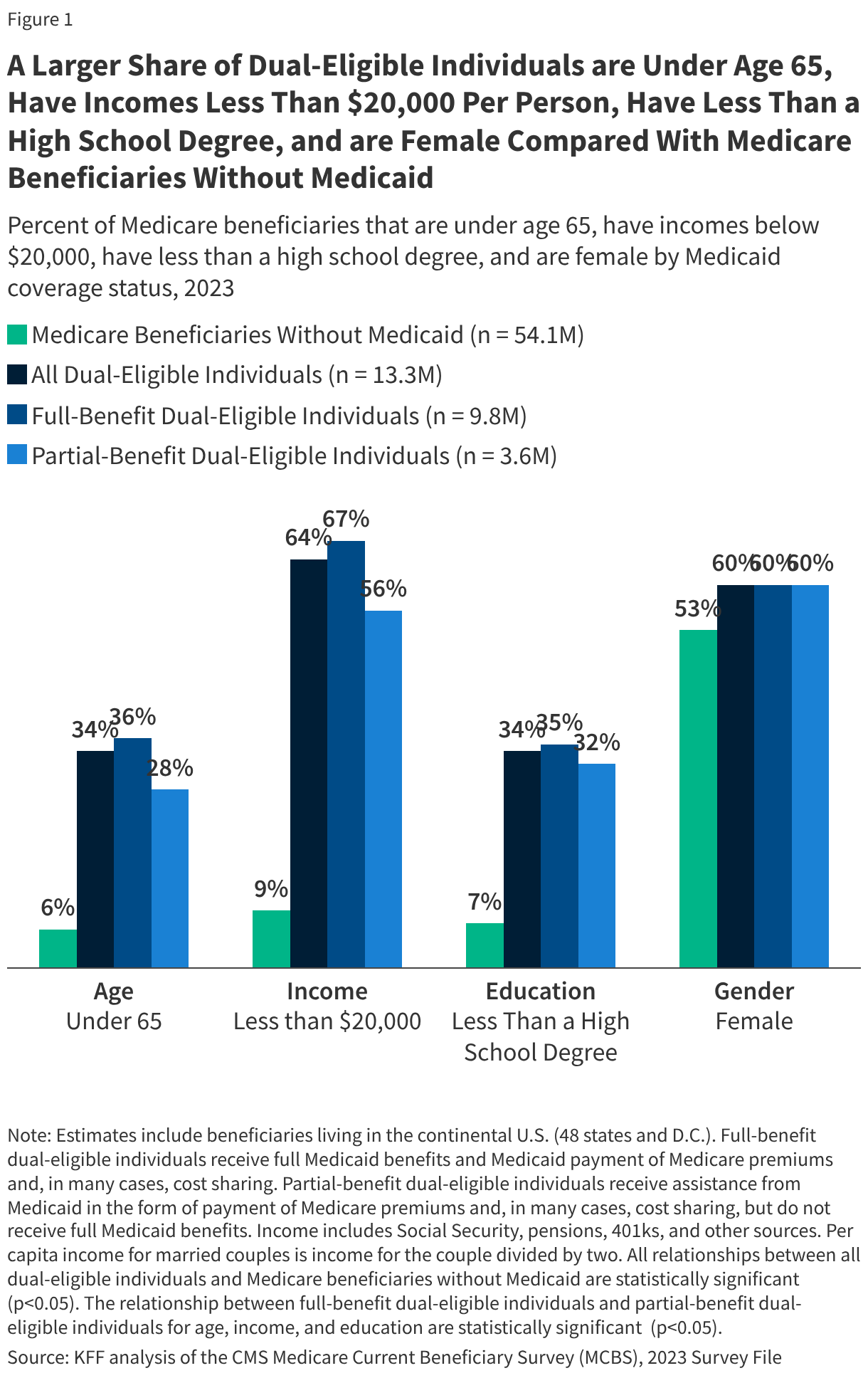
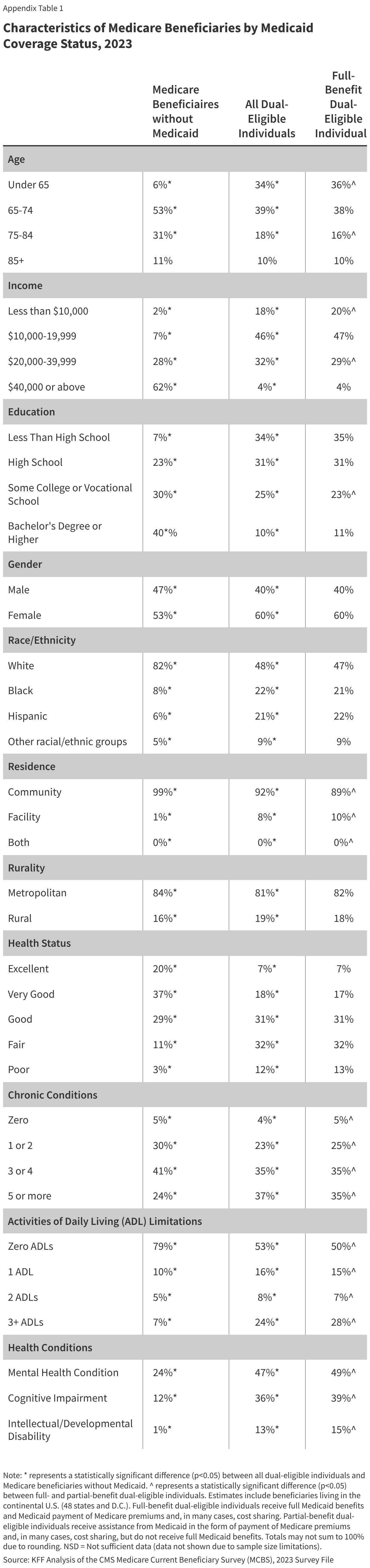
- Compared with Medicare beneficiaries without Medicaid, dual-eligible individuals are more likely to be younger, have lower incomes, and be people of color. Specifically, larger shares of dual-eligible individuals than Medicare beneficiaries without Medicaid are under age 65 (34% vs. 6%), have incomes below $20,000 per person (64% vs. 9%), and are people of color (52% vs. 18%).
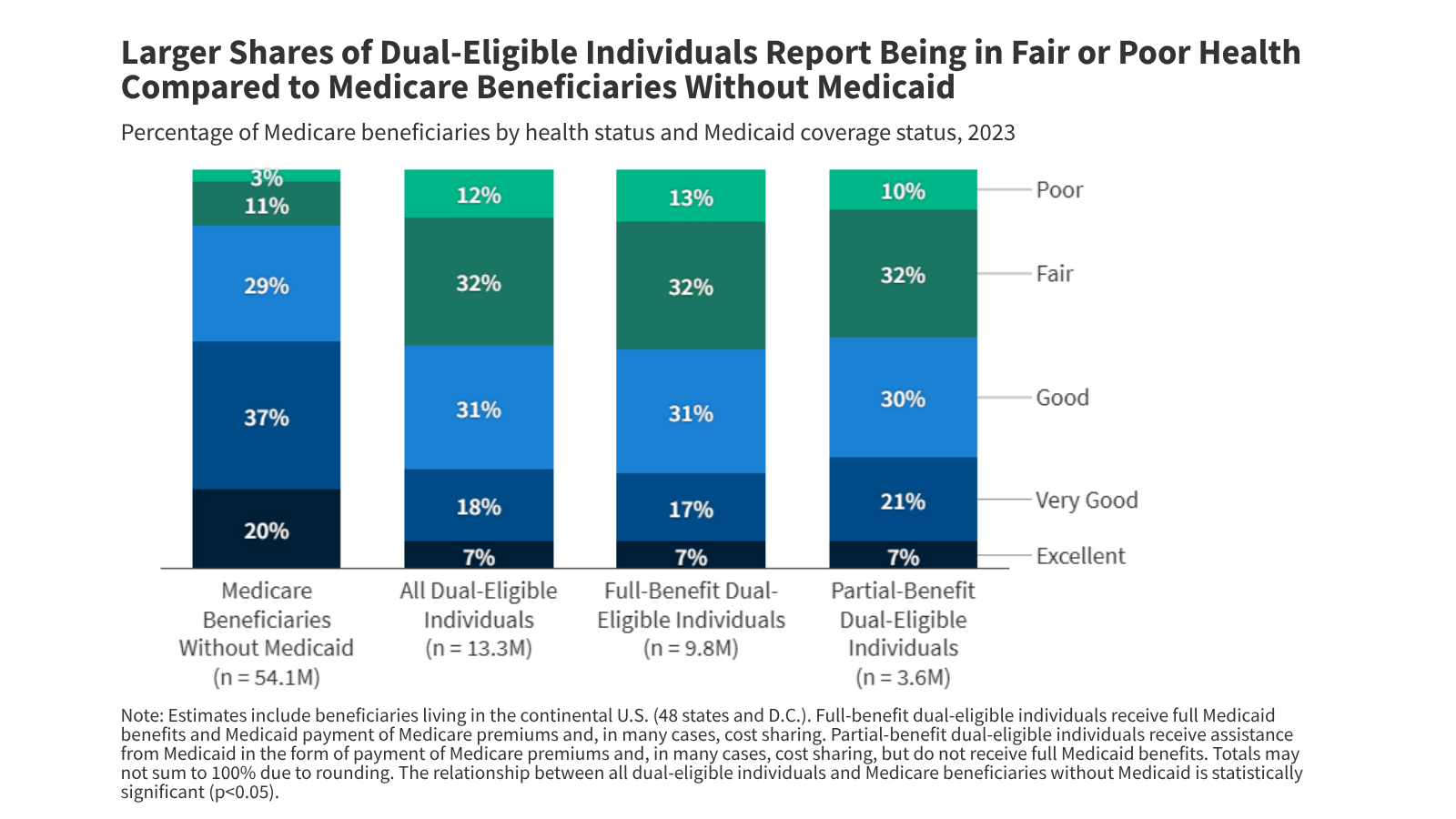
- Dual-eligible individuals are more likely to be in poorer health and have greater health needs than Medicare beneficiaries without Medicaid. For example, 44% of dual-eligible individuals report being in fair or poor health, nearly half (48%) have at least one limitation in an activity of daily living (ADL), and more than one-third (36%) report having a cognitive impairment. Among Medicare beneficiaries without Medicaid, 14% report being in fair or poor health, 21% have at least one ADL limitation, and 12% report having a cognitive impairment.
- There are some differences in the demographic and health characteristics of full- and partial-benefit dual-eligible individuals. For example, compared with partial-benefit dual-eligible individuals, a larger share of full-benefit dual-eligible individuals are under the age of 65 (36% vs. 28%), have at least one ADL limitation (50% vs. 39%), and report an intellectual or developmental disability (15% vs. 5%).
Demographics of Dual-Eligible Individuals
More than one-third (34%) of dual-eligible individuals are under age 65 and qualify for Medicare on account of having a long-term disability, compared with fewer than one in ten (6%) Medicare beneficiaries without Medicaid (Figure 1). Additionally, larger shares of full-benefit dual-eligible individuals than partial-benefit dual-eligible individuals are under age 65 (36% vs. 28%). People under age 65 may qualify for Medicare if they are eligible for Social Security Disability Insurance benefits. Medicare beneficiaries younger than age 65 differ from beneficiaries ages 65 and older in terms of having worse health status, higher per capita Medicare spending, and lower incomes. Similar shares of dual-eligible individuals (10%) and Medicare beneficiaries without Medicaid (11%) are over the age of 85.
Nearly two-thirds (64%) of dual-eligible individuals live on an annual income below $20,000 per person compared with one in ten (9%) Medicare beneficiaries without Medicaid coverage. There are multiple pathways through which Medicare beneficiaries become eligible for Medicaid benefits. All of the Medicaid pathways that are specific to adults ages 65 and older and people with disabilities, including the two most common for dual-eligible individuals – Supplemental Security Income and the Medicare Savings Programs – require beneficiaries to have income and assets below certain thresholds (which vary by pathway). Medicare beneficiaries with higher incomes may become eligible for Medicaid if they “spend down” their income due to large medical or long-term care expenses. Some low-income Medicare beneficiaries may not be qualified to enroll in Medicaid because their assets exceed the limit, they are unaware of the programs, or because administrative burdens prevent them from enrolling.
Over one in three (34%) dual-eligible individuals have less than a high school degree compared with 7% of Medicare beneficiaries without Medicaid. Additionally, similar shares of full-benefit dual-eligible individuals (35%) and partial-benefit dual-eligible individuals (32%) have less than a high school degree.
A slightly larger share of dual-eligible individuals are female compared with Medicare beneficiaries without Medicaid. Six in ten (60%) dual-eligible individuals are female, while just over half (53%) of Medicare beneficiaries without Medicaid are female. The same share of full-benefit and partial-benefit dual-eligible individuals (60%) are female.
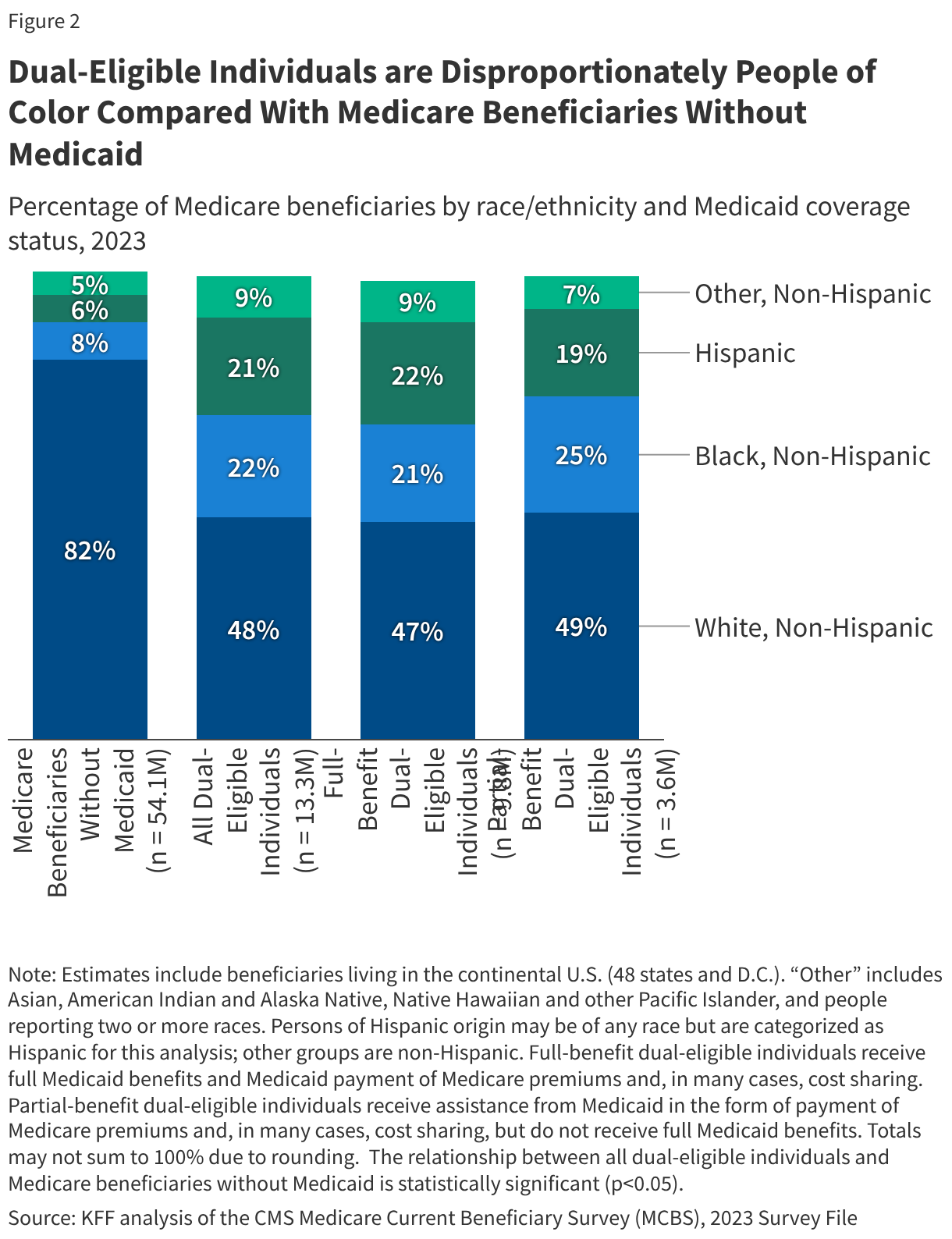
Dual-eligible individuals are disproportionately people of color compared with Medicare beneficiaries without Medicaid (Figure 2). Higher shares of dual-eligible individuals are Black (22% compared with 8% among Medicare beneficiaries without Medicaid), Hispanic (21% compared with 6% of Medicare beneficiaries without Medicaid), or an other non-White, non-Hispanic race and ethnic group (9% compared with 5% of Medicare beneficiaries without Medicaid).
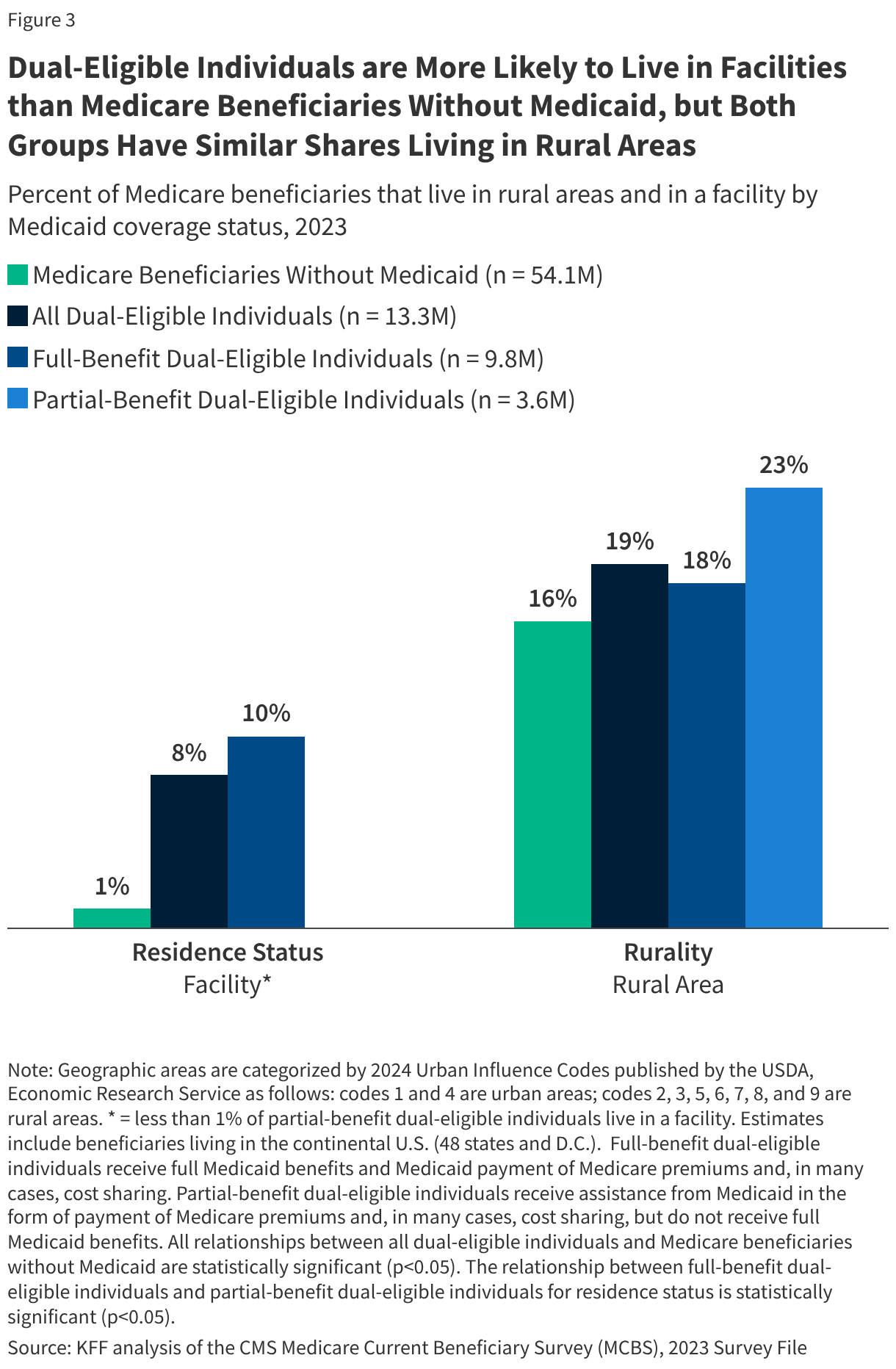
Dual-eligible individuals are more likely than Medicare beneficiaries without Medicaid to live in a long-term care nursing home or other institutional facility (Figure 3). In particular, more full-benefit dual-eligible individuals (10%) live in an institutional setting relative to other Medicare beneficiaries (1% or less of both partial-benefit dual-eligible individuals and Medicare beneficiaries without Medicaid). This likely reflects Medicaid eligibility provisions and the fact that Medicaid is the nation’s primary payer for long-term care services. The average cost of a private room in a nursing facility was $116,800 in 2023. After spending their income and savings to pay for those costs, Medicare beneficiaries without Medicaid may become eligible for Medicaid coverage of long-term care services. In addition, Medicare beneficiaries who use long-term care and who meet other eligibility criteria may qualify for Medicaid if, for example, they can demonstrate the need for an institutional level of care and meet other income and asset criteria.
A slightly larger share of dual-eligible individuals than Medicare beneficiaries without Medicaid live in a rural area. Nearly one in five (19%) dual-eligible individuals compared with 16% of Medicare beneficiaries without Medicaid live in a rural area. There are similar shares of full- and partial-benefit dual-eligible individuals who live in rural areas.
Health Characteristics of Dual-Eligible Individuals
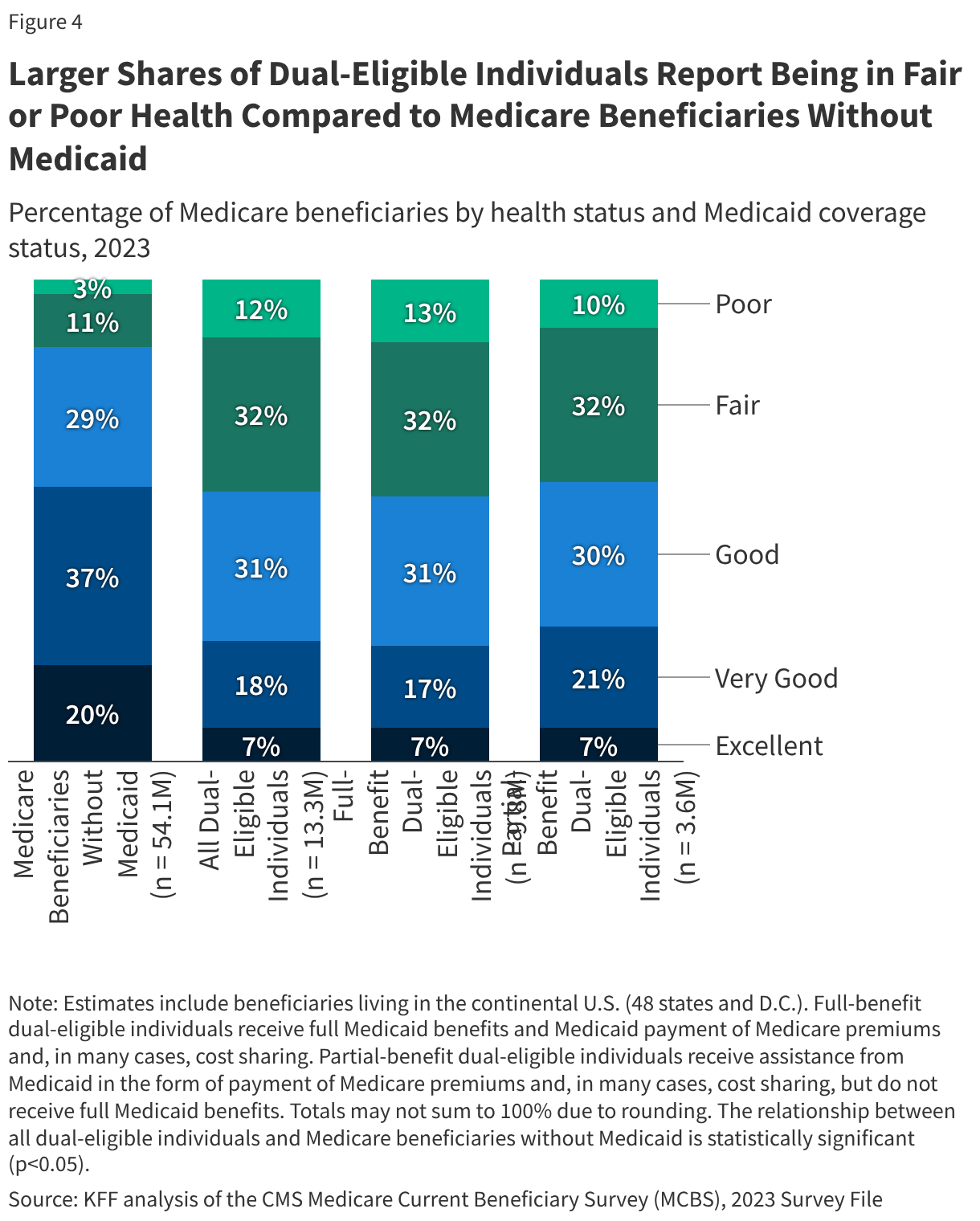
More than four in ten (44%) dual-eligible individuals report being in fair or poor health compared with 15% of Medicare beneficiaries without Medicaid coverage (Figure 4). Conversely, over half (57%) of Medicare beneficiaries without Medicaid report being in very good or excellent health, which is twice as large as the share of dual-eligible individuals (25%) that report very good or excellent health. A slightly larger share of partial-benefit dual-eligible individuals report being in very good or excellent health (28%) compared with full-benefit dual-eligible individuals (24%).
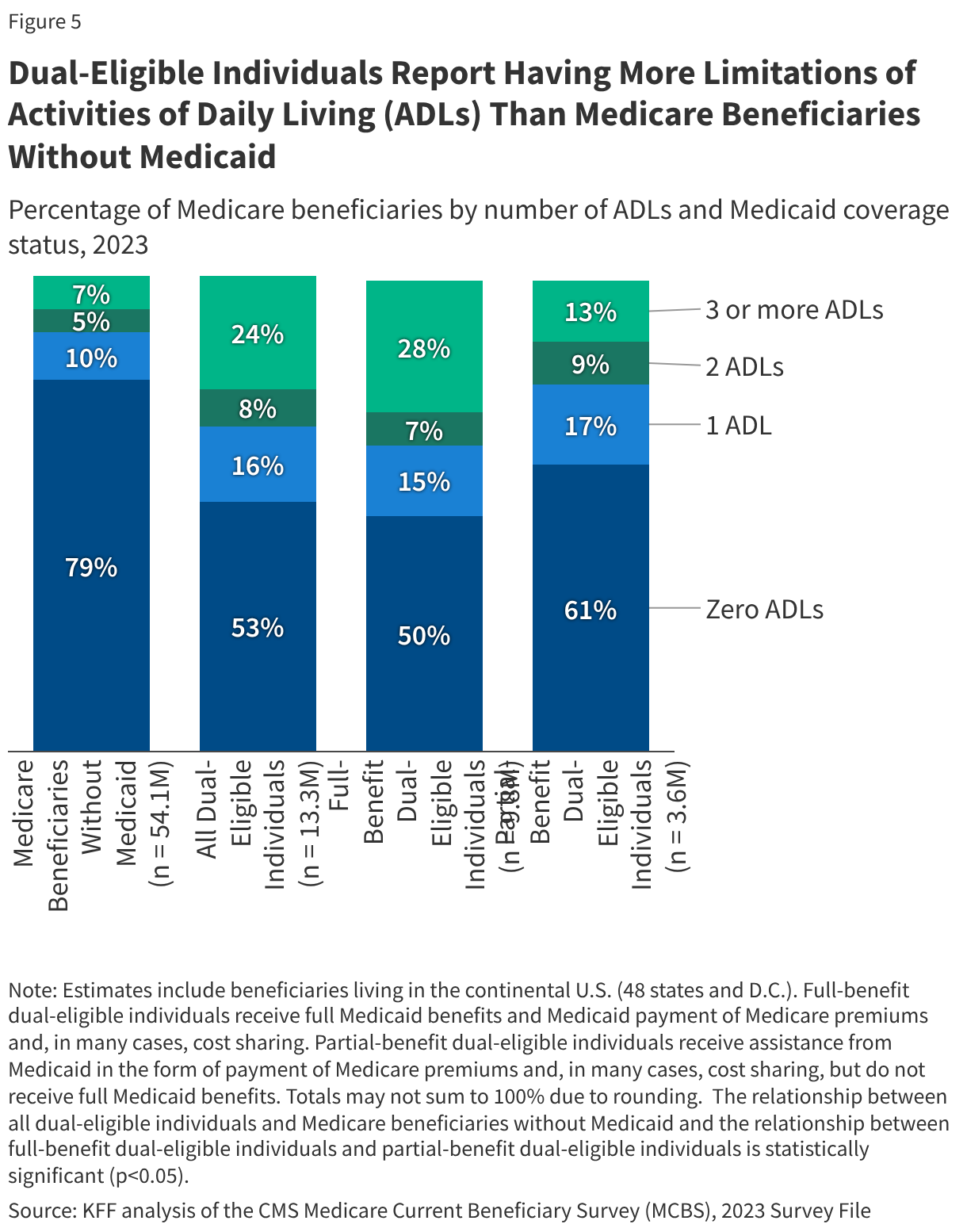
Dual-eligible individuals are more likely than Medicare beneficiaries without Medicaid to report having difficulty with one or more activities of daily living (such as eating, bathing, and dressing) (Figure 5). Just under half (47%) of dual-eligible individuals report having difficulty performing at least one activity of daily living (ADL), including about one in four (24%) who report difficulty with three or more ADLs. That compares with about one in five (21%) Medicare beneficiaries without Medicaid who report at least one ADL limitation, including just 7% who report limitations with at least three ADLs. A larger share of full-benefit (50%) than partial-benefit (39%) dual-eligible individuals report difficulties with at least one ADL.
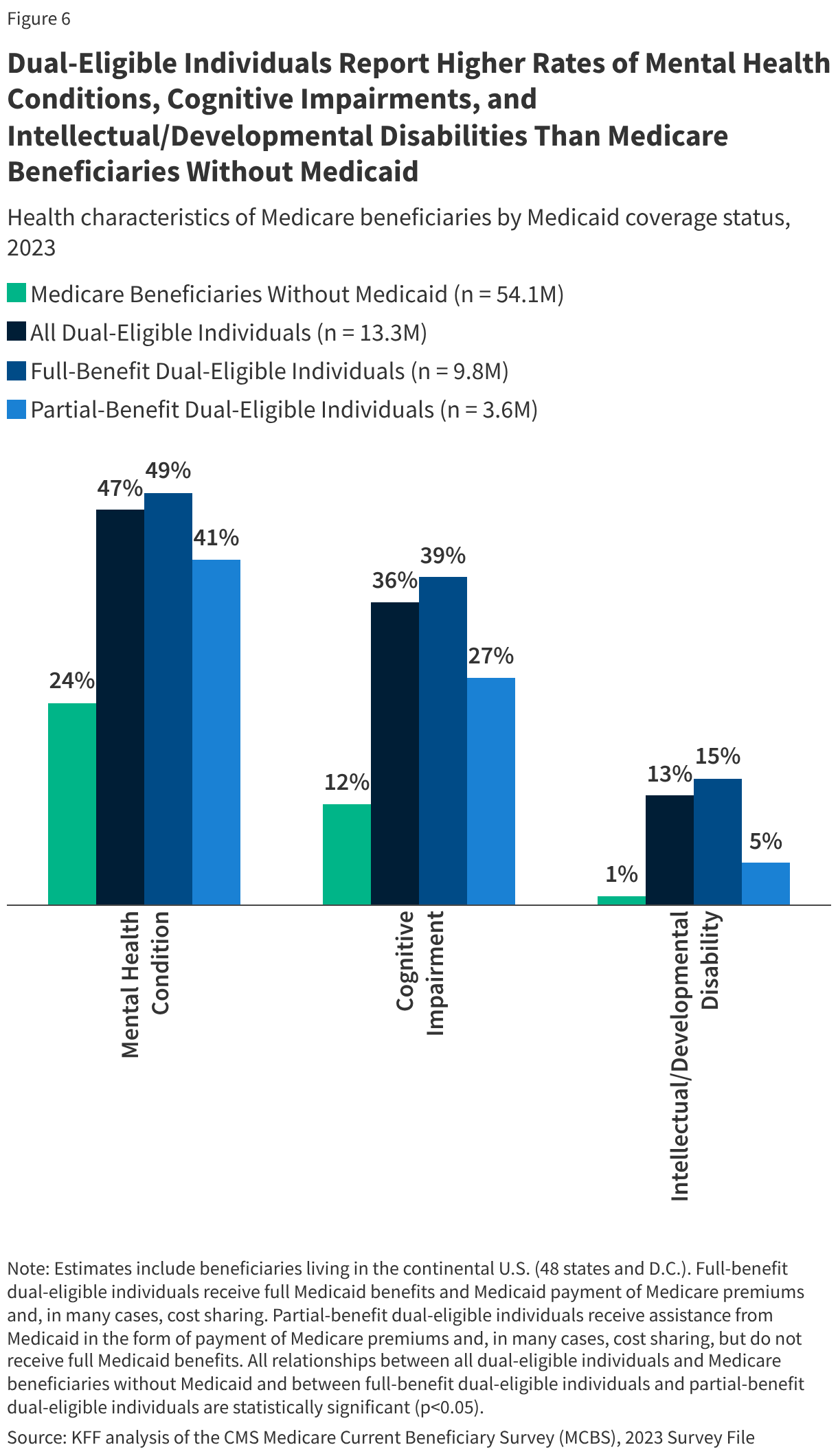
Dual-eligible individuals report higher rates of mental health conditions, cognitive impairments, and intellectual and developmental disabilities. Most dual-eligible individuals receive their Medicare and Medicaid benefits through separate coverage arrangements. Difficulty navigating the Medicare and Medicaid programs can lead to fragmented care, lower quality, and higher costs. For people with mental health conditions, cognitive impairments, or intellectual or developmental disabilities, the challenge of navigating coverage under both programs could be even larger.
Dual-eligible individuals are about twice as likely to report having a mental health condition as Medicare beneficiaries without Medicaid coverage (Figure 6). About half (47%) of dual-eligible individuals report having a mental health condition, such as depression, compared with less than one-fourth (24%) of Medicare beneficiaries without Medicaid coverage. The share of full-benefit dual-eligible individuals with a mental health condition (49%) is somewhat higher than the share of partial-benefit dual-eligible individuals with a mental health condition (41%).
The share of beneficiaries who report having a cognitive impairment is three times larger among dual-eligible individuals than among Medicare beneficiaries without Medicaid. Specifically, 36% of dual-eligible individuals report a cognitive impairment, including difficulty concentrating, remembering, or making decisions, compared with 12% of Medicare beneficiaries without Medicaid. The share of full-benefit dual-eligible individuals (39%) that report a cognitive impairment is larger than the share of partial-benefit dual-eligible individuals (27%) reporting a cognitive impairment.
The share of dual-eligible individuals who report having an intellectual or developmental disability is much higher than that of Medicare beneficiaries without Medicaid. Overall, 13% of dual-eligible individuals report having an intellectual or developmental disability compared with only 1% of Medicare beneficiaries without Medicaid coverage. Full-benefit dual-eligible individuals are about three times as likely to report having an intellectual or developmental disability than partial-benefit dual-eligible individuals (15% vs. 5%, respectively).
This work was supported in part by Arnold Ventures. KFF maintains full editorial control over all of its policy analysis, polling, and journalism activities.
Medicaid,Medicare,Demographics,Dual Eligible IndividualsDemographics,Dual Eligible Individuals#Profile #DualEligible #Individuals1784137293
