


Data collected for this analysis represent the largest insurers in each business segment — those with at least 2.5% market share in each of their respective markets: Medicare Advantage, Medicaid managed care, and the ACA FFM.3,4 In total, this analysis includes data from 14 unique insurers, representing 25 million Medicare Advantage enrollees (69% of all enrollment), more than 35 million Medicaid managed care organization (MCO) enrollees (54% of all enrollment), and nearly 11 million enrollees in the ACA FFM (hereafter referred to as the ACA Marketplace for simplicity), which included 28 states in 2025 (74% of all enrollment in FFM states). KFF weighted the data by enrollment within each market segment. See the Methodology section for more details.
This analysis includes the share of standard and expedited prior authorization requests that were approved and denied, the share of standard prior authorization requests that were approved after appeal, and the median response times for standard and expedited prior authorization requests. We do not report the share of prior authorization requests approved after extension because some insurers reported the data only for standard requests, while others reported data separately for standard and expedited. Optional metrics are not included because they were not consistently reported by insurers.
Approval and Denial Rates
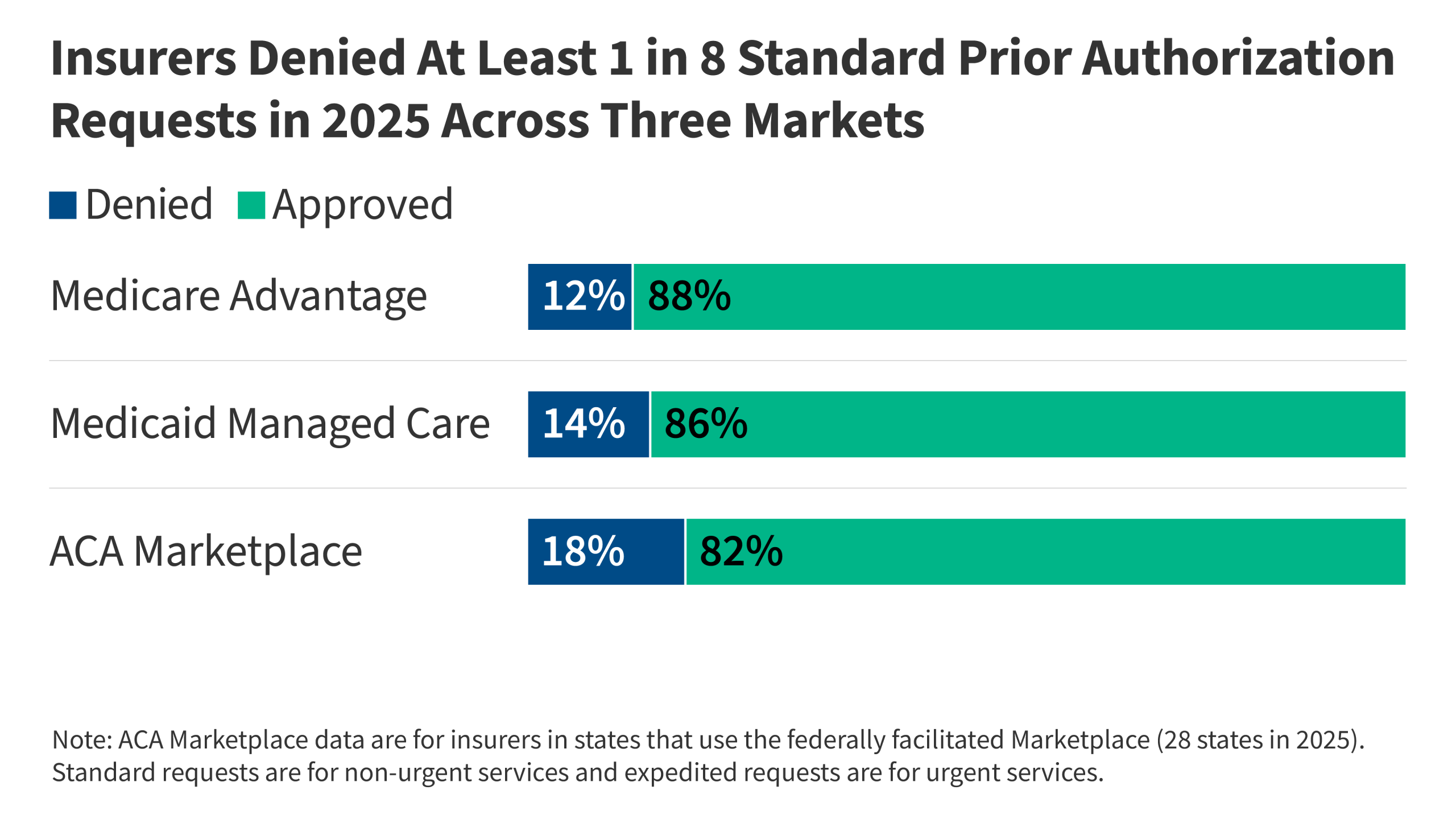
Across market segments, insurers denied between 12% and 18% of standard prior authorization requests in 2025. On average, 12% of standard prior authorization requests and 10% of expedited prior authorization requests were denied in Medicare Advantage; 14% of standard requests and 12% of expedited requests were denied in Medicaid managed care; and 18% of standard prior authorization requests and 16% of expedited prior authorization requests were denied in the ACA Marketplace (Figure 1). Across all markets, the share of standard prior authorization requests that were denied was similar to or slightly higher than the share of expedited prior authorization requests that were denied.
Prior authorization denial rates varied widely across the largest insurers (Figure 2).
Medicare Advantage: Among the six Medicare Advantage insurers examined, the share of standard prior authorization requests that were denied ranged from 5% (Elevance) to 17% (UnitedHealth Group), and the share of expedited requests that were denied ranged from 3% (Elevance) to 13% (Centene). UnitedHealth Group, Centene, Kaiser Permanente, and Elevance all had somewhat higher denial rates for standard requests than expedited requests, while CVS and Humana had higher denial rates for expedited requests than standard requests. These are similar to the overall denial rates found in a previous KFF analysis across Medicare Advantage insurers.5
Medicaid Managed Care: Among the eight Medicaid managed care insurers examined, the share of standardprior authorization requests that were denied ranged from 2% (L.A. Care Health Plan) to 23% (Independence Health Group). For expedited requests, denial rates ranged from 4% (L.A. Care Health Plan) to 21% (CareSource). Three insurers (Centene, Independence Health Group, and UnitedHealth Group) reported higher denial rates for standard requests compared to expedited requests, while three insurers (CVS Health, CareSource, and L.A. Care Health Plan) reported slightly higher denial rates for expedited requests.6
ACA Marketplace: Among the eight ACA Marketplace insurers included in this analysis, the share of standard prior authorization requests that were denied ranged from an average of 3% (GuideWell) to 25% (Centene). Denial rates for expedited requests ranged from 3% (GuideWell) to 23% (Centene). Four insurers (Centene, UnitedHealth Group, Blue Cross and Blue Shield of North Carolina, and Molina) reported higher denial rates for standard requests compared to expedited requests, while two insurers (Elevance and Health Care Service Corporation) reported higher denial rates for expedited requests.7 The remaining two insurers (Oscar and GuideWell) in this analysis had virtually the same rates of denials for both standard and expedited requests.
Market segments inherently have many differences, and the share of prior authorization requests denied also varied for the same insurer participating in multiple markets. For example, UnitedHealth denied 17% of standard requests in Medicare Advantage, 11% in Medicaid managed care, and 21% in the ACA Marketplace.
Appeals Data
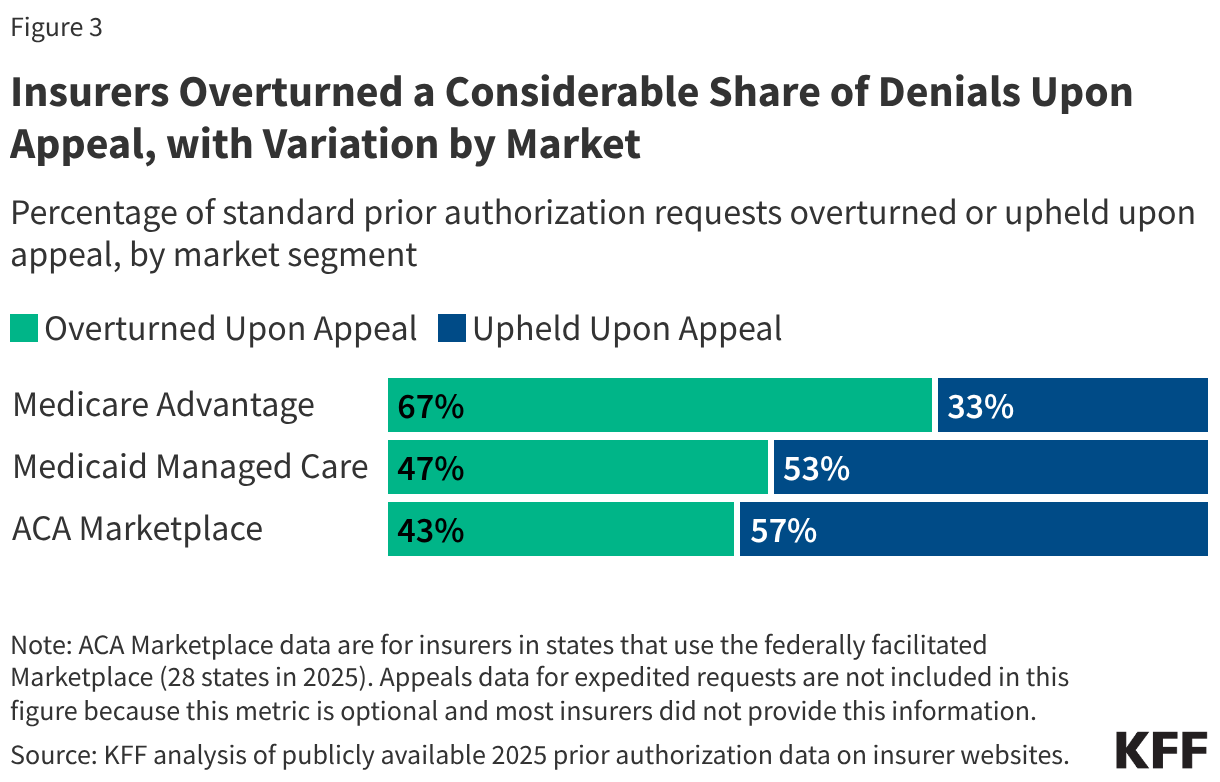
Insurers overturned a considerable share of denials upon appeal, with variation by market. Although enrollees or their providers can appeal denied prior authorization requests, research shows that denials are rarely appealed in Medicare Advantage, Medicaid MCOs, or the ACA Marketplace. However, the prior authorization data demonstrate that when denials are appealed, a considerable share are overturned.
The share of standard prior authorization requests initially denied that were then overturned upon appeal8 (referred to in the CMS template as “Requests Approved After Appeal”) was 67% for Medicare Advantage, 47% for Medicaid managed care, and 43% in the ACA Marketplace (Figure 3). We do not present appeals data for expedited requests because that metric is optional, and most insurers did not provide this information. High overturn rates could raise questions about whether the initial request should have been approved or could indicate that the initial request was missing the required documentation to justify the service. Either way, the appeals process can be complicated and time-consuming for providers and patients.
In Medicare Advantage, if the plan upholds its original denial, the case is automatically sent to an independent review entity. In contrast, there is no automatic external medical review of upheld denials in Medicaid managed care and the ACA Marketplace. HHS OIG has suggested that the presence of automatic, independent review could incentivize Medicare Advantage plans to closely review their denials at the first level of appeal and may help explain higher appeal overturn rates in Medicare Advantage compared to Medicaid managed care and the ACA Marketplace.
Appealed prior authorization denials were overturned more often by some large insurers than others (Figure 4).
Medicare Advantage: Across the six largest Medicare Advantage insurers, the share of denied standard prior authorization requests that were approved varied substantially. Denials were overturned upon appeal more than 90% of the time by Centene, while Kaiser Permanente overturned denials upon appeal 40% of the time.
Medicaid Managed Care: Among the Medicaid managed care insurers examined, UnitedHealth Group overturned 81% of denials upon appeal. The remaining insurers overturned between 22% (CVS) and 48% (Molina) of denials upon appeal. (One Medicaid managed care insurer included in this analysis (L.A. Care Health Plan) did not report overturned prior authorization denials as a percentage of standard prior authorization requests that were appealed; therefore, its appeals data are not included here.)
ACA Marketplace: On average, Health Care Service Corporation overturned just 16% of denials upon appeal, while Centene overturned just over half (54%) of denials upon appeal. Six of the eight large insurers reported overturning denials upon appeal less than half the time.
Median Response Times
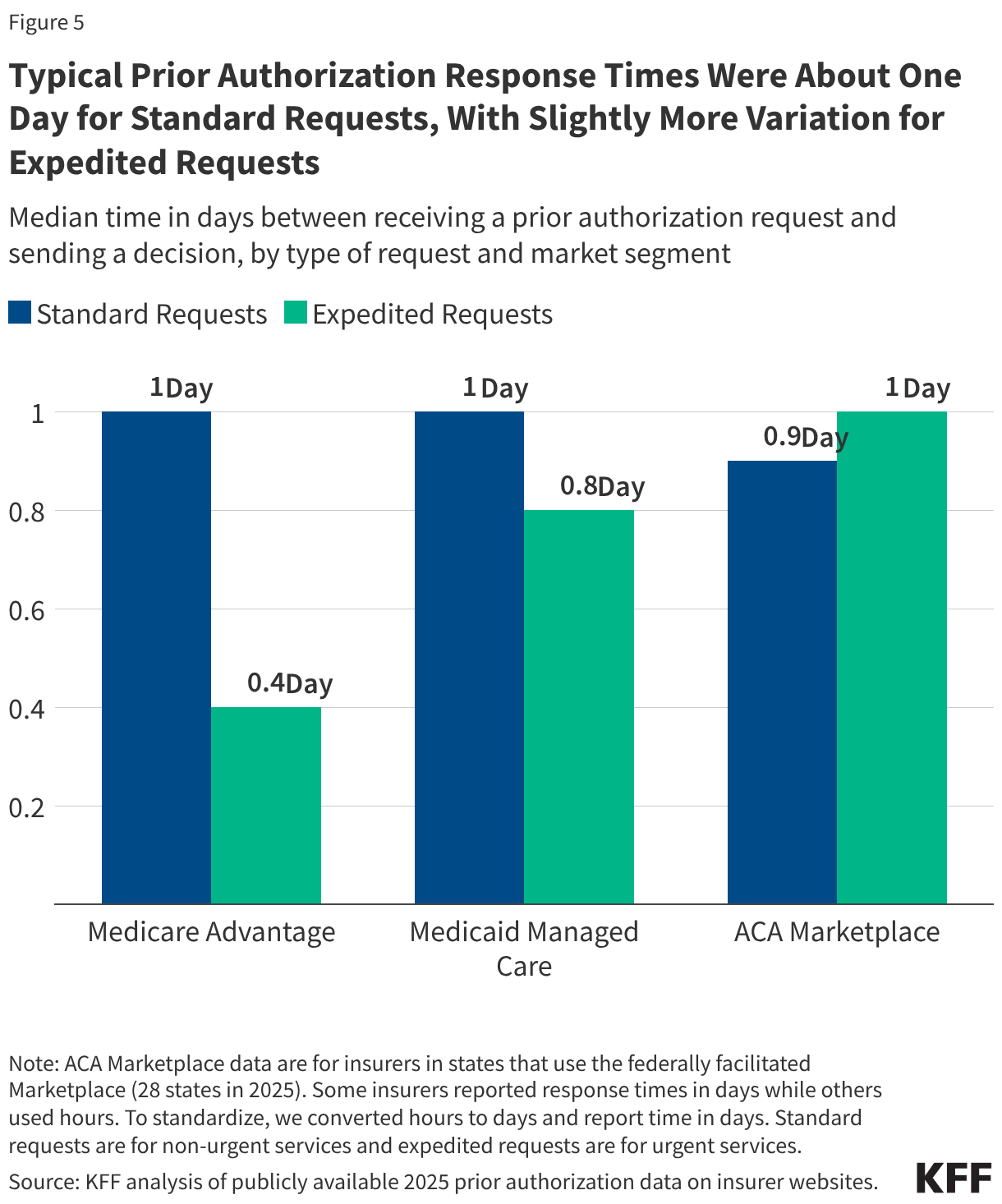
Median response times for prior authorization determinations were about 1 day for standard requests, with slightly more variation for expedited requests (Figure 5).
The median time between the submission of a prior authorization request and the determination by the insurer, or response time, for standard requests was about 1 day for Medicare Advantage, Medicaid managed care, and the ACA Marketplace (0.9 days or just under 22 hours), substantially less than the federally required maximum time permitted for standard requests.9 The median response time for expedited requests was about half a day (0.4 days or just under 10 hours) for Medicare Advantage, just under 1 day (0.8 days or approximately 19 hours) for Medicaid managed care, and 1 day for the ACA Marketplace. Federal regulations in 2025 required insurers to send a determination for standard requests within 14 calendar days for Medicare Advantage and Medicaid managed care and within 15 days for the ACA Marketplace. Determinations for expedited requests had to be sent within 72 hours for insurers in all three markets.10
Median response times likely reflect (at least in part) the increasing use of technology in the prior authorization process, such as artificial intelligence and electronic prior authorization systems. Still, nearly one-quarter (24%) of insured adults reported in a July 2025 KFF poll that their health insurance company had delayed their ability to get a requested health care service, treatment, or medication in the past two years.And other research and media reports demonstrate that some patients experience much longer response times, sometimes with serious health consequences. In addition to the 2024 regulation’s provisions aimed at streamlining and automating the prior authorization process, in June 2025, a group of health insurers voluntarily pledged to expand real-time responses for prior authorization approvals by 2027.
Median response times for prior authorization determinations varied somewhat among large insurers (Figure 6).
Medicare Advantage: The median response time for standard requests varied from less than 1 day (CVS, Humana, and Kaiser Permanente) to 2 days (Centene). Across the six insurers examined, the response times for expedited requests were similar or slightly shorter than the response times for standard requests.
Medicaid Managed Care: The median response time for standard prior authorization requests varied from 1 day (Centene, Elevance, and Molina) to 4 days (CareSource). Elevance had the same median response time for standard and expedited requests, while the other insurers reported shorter response times for expedited requests.
ACA Marketplace: Among the eight large insurers included in this analysis, median response times for standard requests ranged from less than 1 day (UnitedHealth Group, GuideWell, and Health Care Service Corporation) to 4 days (Molina). All but one insurer reported similar or shorter median response times for expedited requests than standard requests.
Affordable Care Act,Medicaid,Medicare,Patient and Consumer Protections,Private Insurance,ACA Marketplaces,Managed Care,Medicare Advantage,Prior AuthorizationACA Marketplaces,Managed Care,Medicare Advantage,Prior Authorization#Prior #Authorization #Metrics #Provide #Insights #Insurer #Practices #Gaps #Remain1786623581
