


By 2050 there will be 35 million cancer cases annually – a 66.7% increase in incidence from 2024.
That is, unless urgent action is taken to improve prevention and access to early diagnosis and treatment, according to a report released Wednesday by the World Health Organization (WHO).
Currently, cancer kills 26,000 people daily and is the second leading cause of death after cardiovascular disease. Fewer than one in three countries include cancer care in their universal health coverage (UHC) packages.
Presently, there are an estimated 20.6 million new cases and close to 10 million deaths annually.
A silver lining is that key policy interventions have led to a 27% decline in tobacco use worldwide since 2010, contributing to reductions in lung cancer cases and deaths in some regions.
But other key preventive measures, including obesity, infections and obsessive alcohol consumption need more assertive action – along with even more progress on tobacco.:
These are the takeaways of the Global Status Report on Cancer 2026 jointly developed with the International Agency for Research on Cancer (IARC).
“Cancer is a deeply personal disease that touches nearly all of us. But whether a person survives cancer should never depend on where they were born or what they earn,” said WHO Director-General Dr Tedros Adhanom Ghebreyesus.
According to the report, based on data from 2024, “the leading contributors to cancer cases globally were tobacco use, infections, alcohol consumption, and high body-mass index (BMI) accounting for 15%, 10%, 3% and 2% of all new cancer cases, respectively.”
The report also highlights persistent inequities in access to timely cancer diagnosis and treatment. While 87% of women with breast cancer survive five years after their diagnosis in high-income countries, only about 42% do so in low-income countries, the report finds.
In terms of infections, human papillomavirus (HPV) is a leading cause of cervical cancer – another leading killer of women in low-income countries who lack access to regular cervical cancer screenings. While HPV vaccine uptake has increased, there are still wide gaps in coverage especially in large parts of Africa, the Middle-East and Asia.
“The inequities documented in this report are not inevitable; they are the consequence of choices, and they can be reversed through stronger and unified action,” Tedros said.
The report is the first comprehensive analysis of the global status of cancer prevention and control, projections of future trends – and progress made since 2010, the baseline year chosen for the analysis.
Along with the progress seen on tobacco, alcohol consumption has fallen, but only marginally, and screenings for breast as well as cervical cancer have improved in both high and low-income countries.
Asia, Europe have large cancer burden
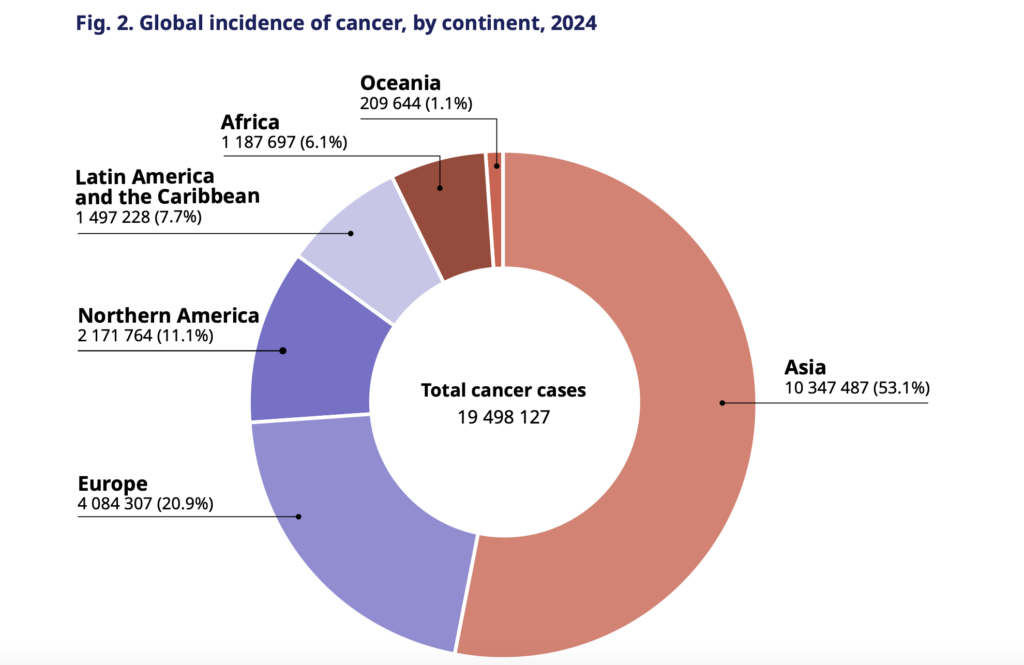
In 2024, Asia accounted for the largest share of cancer cases, with more than half of all cancer cases (50.7%) and deaths (56.5%), reflecting its large population.
Europe too carried a disproportionately high burden, contributing 21% of global cases and 20% of deaths despite having only about 9% of the world’s population. In contrast, many countries in Africa and parts of Asia experience lower incidence but disproportionately high mortality.
Nearly four in ten cancer cases globally are linked to preventable risk factors, particularly infections such as human papillomavirus (HPV), hepatitis B and C, and helicobacter pylori, alcohol, tobacco use, high body mass index and insufficient physical activity, highlighting the critical role of prevention.
Not all preventable risk factors are receiving enough attention, experts noted.
“For obesity, for example, a lot of the prevention strategies that exist today have been implemented or taken in high-income countries, mainly, while in the low and middle-income countries, we see the take-up of these programmes are then much less,” Dr Isabelle Soerjomataram, Deputy Head of the IARC Cancer Surveillance Unit said, speaking at a press conference to launch the report.
Gendered impact of the disease
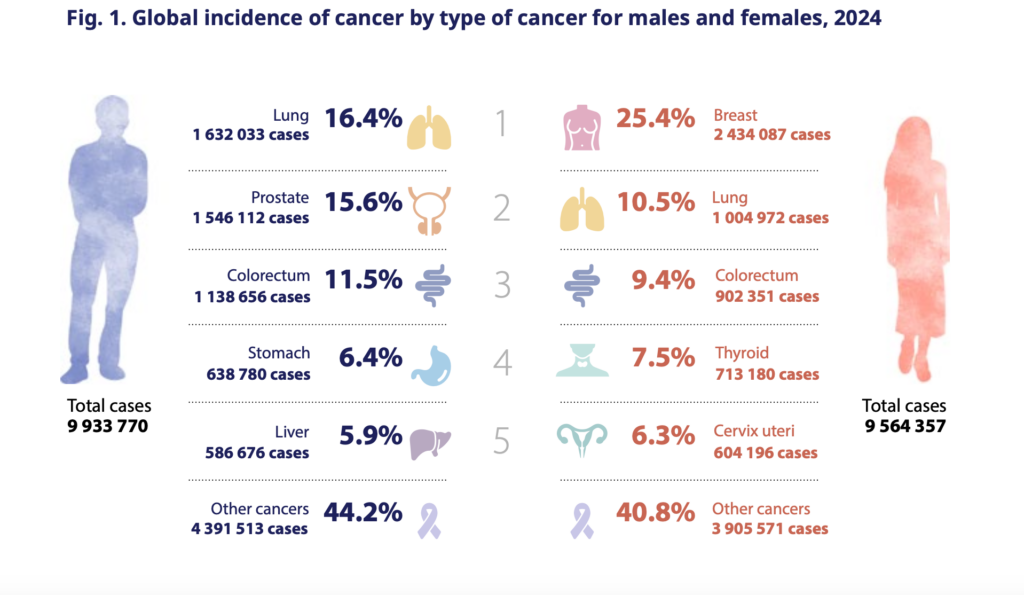
Among the different types of cancer, lung cancer remains the leading cause of cancer death globally.
Overall, lung, prostate and colorectal cancers are among the most common cancers in men, while breast, lung and colorectal cancers account for a substantial share of the burden among women.
Cancer still carries stigma, especially for women.
“After my own double mastectomy, I struggled with body image, but I knew that that surgery had given me the best chance at life. Yet I met four women who chose to die rather than lose a breast to breast cancer. That is the devastating power of stigma,” said Abigail Simon-Hart, a breast cancer survivor and patient advocate.
Experts drew attention to the impact on men as well. “There’s also the very real impact of cancer on men, and that age-standardized incidence rates for cancer in men is higher, and many men are also being left behind,” said Dr Andre Ilbawi, Team Lead for Cancer Control, WHO.
Major gains but gaps persist
The report notes substantial gains in key policy areas. Apart from the decline in tobacco use contributing to the reduction in lung cancer cases and deaths in some regions, infection-related cancers are also decreasing thanks. This is due to the expanding vaccination coverage and improved water, sanitation and hygiene (WASH) as well as infection prevention and control.
Around 82% of countries now have national cancer control plans, up from 50% in 2010.
In high-income countries, early detection programmes catch most breast cancers and 74% of women have been screened for cervical cancer.
Scientific innovation is accelerating; registered clinical trials have increased at an annual rate of 7.3% between 2005 and 2021.
But essential cancer medicines remain out of reach for many. Availability of the top 20 priority cancer medicines ranges from just 9% to 54% in low- and lower-middle-income countries, compared with 68% to 94% in high-income countries. And the consequences of these gaps are felt most acutely by people living with cancer and their families.
Toll on caregivers, community
Cancer care remains financially and socially devastating for many households.
At least 45% experience financial hardship, more than half report mental health challenges, and nearly all caregivers report strain including unpaid services and social isolation, the WHO’s first-ever survey of people affected by cancer found that covered 4,000 people across 116 countries.
“To succeed against cancer, we must continue to focus on technological innovation, and we must also create the conditions that empower and care for people more holistically,” Ilbawi said.
Image Credits: WHO/Yasin Abdullahi, Unsplash/National Cancer Institute, Global status report on cancer 2026, Etinosa Yvonne/WHO.
Combat the infodemic in health information and support health policy reporting from the global South. Our growing network of journalists in Africa, Asia, Geneva and New York connect the dots between regional realities and the big global debates, with evidence-based, open access news and analysis. To make a personal or organisational contribution click here.
Cancer,Content type,News,Non-Communicable Diseases,Public Health,#UHC,caregivers,Global Status Report on Cancer 2026,Universal Health Coverage,WHO,world health organization#Million #Annual #Cancer #Cases #Action #Warns1783531488
