

Subscribe to Updates

    Get the latest creative news from FooBar about art, design and business.

    What's Hot

    Journalists Cover Cyclospora and Measles Outbreaks, and Changing Health Policies

    August 8, 2026

    Alarming Ebola Spread Raises Question of Viral Mutation

    August 7, 2026

    Variability in Rebimbursement Rates for State Funded Abortion Services for Medicaid Enrollees: A 2026 Update

    August 7, 2026
    Facebook Twitter Instagram
    Health Care Providers & FacilitiesHealth Care Providers & Facilities
    • Health
    • Nutrition
    Facebook Twitter Instagram
    SUBSCRIBE
    • Homepage
    • Health

      Variability in Rebimbursement Rates for State Funded Abortion Services for Medicaid Enrollees: A 2026 Update

      August 7, 2026

      The Trump Administration’s Foreign Aid Review: Status of U.S. Support for Gavi, the Vaccine Alliance

      August 7, 2026

      The Trump Administration’s Foreign Aid Review: Status of the President’s Malaria Initiative (PMI)

      August 7, 2026

      The Trump Administration’s Foreign Aid Review: Status of Global Health Security/Pandemic Preparedness

      August 7, 2026

      The Trump Administration’s Foreign Aid Review: Status of U.S. Family Planning and Reproductive Health Efforts

      August 7, 2026
    • News
      1. Health
      2. View All

      Variability in Rebimbursement Rates for State Funded Abortion Services for Medicaid Enrollees: A 2026 Update

      August 7, 2026

      The Trump Administration’s Foreign Aid Review: Status of U.S. Support for Gavi, the Vaccine Alliance

      August 7, 2026

      The Trump Administration’s Foreign Aid Review: Status of the President’s Malaria Initiative (PMI)

      August 7, 2026

      The Trump Administration’s Foreign Aid Review: Status of Global Health Security/Pandemic Preparedness

      August 7, 2026

      Tens of thousands of young people get vital protection from MenB in just a fortnight

      August 3, 2026

      NHS inviting 500,000 men to join major prostate cancer research programme

      August 2, 2026

      Hundreds of thousands of women access free morning-after pill at NHS pharmacies in first 5 months

      July 27, 2026

      Thousands with MS to get “life-changing” drug on NHS to help them walk more freely

      July 22, 2026
    • Nutrition
    • Fitness
    • Lifestyle
    • Privacy Policy
    Health Care Providers & FacilitiesHealth Care Providers & Facilities
    Home»Health»Five Key Facts About Spending and Enrollment for People with Medicare and Medicaid (Dual-Eligible Individuals)
    Health

    Five Key Facts About Spending and Enrollment for People with Medicare and Medicaid (Dual-Eligible Individuals)

    adminBy adminJuly 15, 2026No Comments5 Mins Read
    Facebook Twitter Pinterest LinkedIn Tumblr Reddit WhatsApp Email
    Five Key Facts About Spending and Enrollment for People with Medicare and Medicaid (Dual-Eligible Individuals)
    Share
    Facebook Twitter LinkedIn Pinterest WhatsApp Email

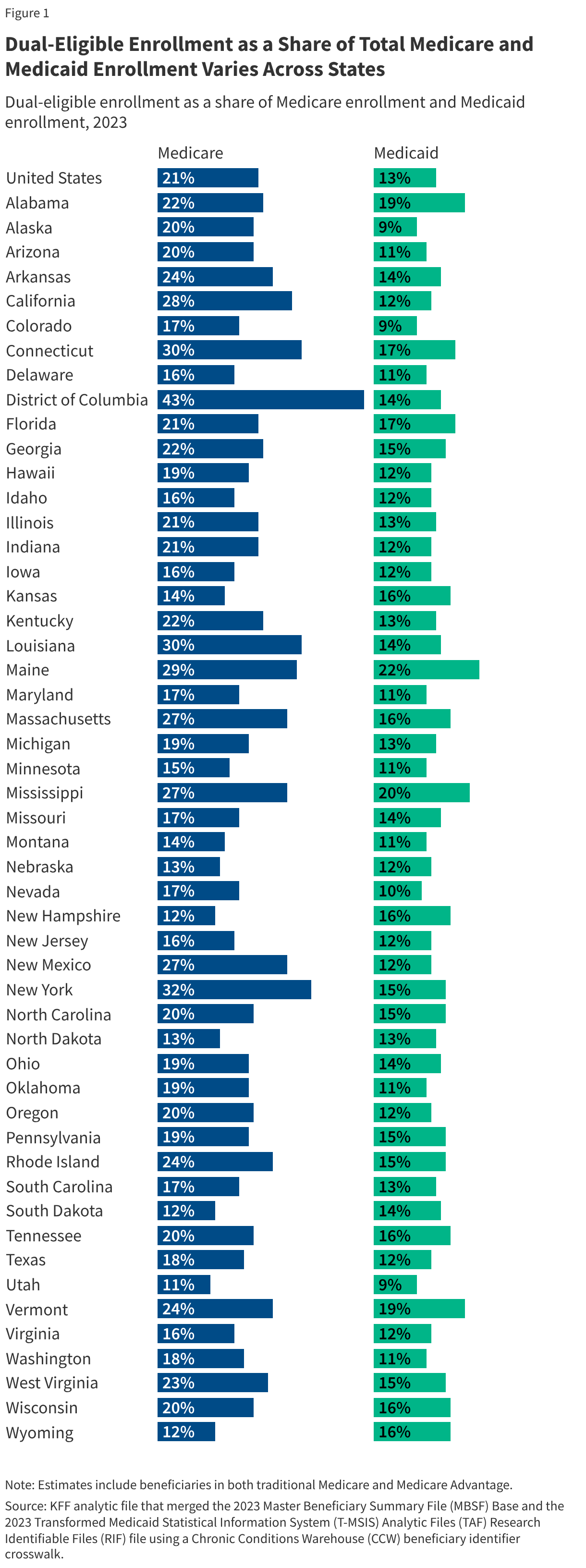
    1. Dual-eligible individuals represent 21% of Medicare beneficiaries and 13% of Medicaid enrollees nationally, although state shares vary.

    Dual-eligible individuals comprise 21% of the total Medicare population (including beneficiaries in both traditional Medicare and Medicare Advantage) and 13% of the total Medicaid population, but the shares vary widely across states. Dual-eligible individuals comprise 30% or more of all Medicare beneficiaries in the District of Columbia, New York, Connecticut, and Louisiana, but only 11% in Utah. Dual-eligible individuals comprise 20% or more of all Medicaid enrollees in Maine and Mississippi, but less than 10% in Utah, Colorado, and Alaska. Variation across states reflects an array of factors including the distribution of income and wealth among the state populations, the age distribution of state populations, and Medicaid eligibility criteria.

    Dual-Eligible Enrollment as a Share of Total Medicare and Medicaid Enrollment Varies Across States (Split Bars)

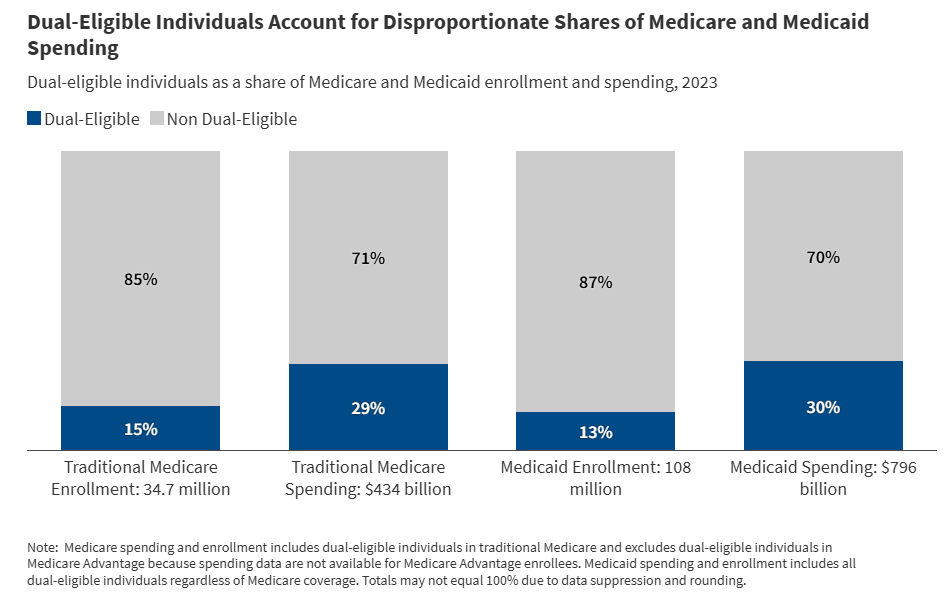
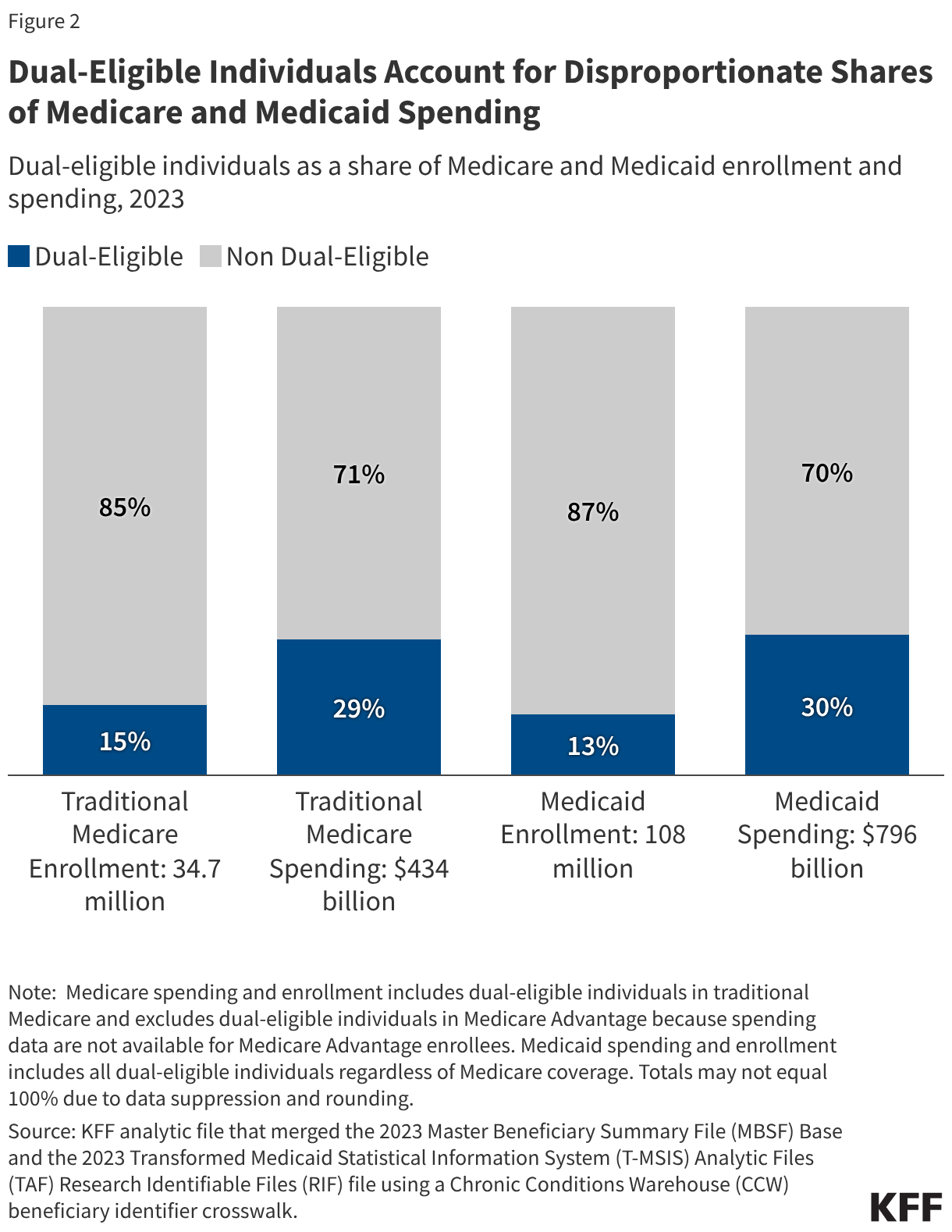
    2. Dual-eligible individuals account for disproportionate shares of Medicare and Medicaid spending.

    Dual-eligible individuals account for a larger share of spending in each program than their respective shares of Medicare and Medicaid enrollment. Dual-eligible individuals comprise 15% of the traditional Medicare population but account for 29% of traditional Medicare spending (or $127 billion of $434 billion). (Those estimates include spending for the 5.3 million dual-eligible individuals in traditional Medicare only, excluding the 9.2 million dual-eligible individuals who had Medicare Advantage coverage in the year because Medicare spending data are not available for beneficiaries enrolled in Medicare Advantage plans). Dual-eligible individuals comprise 13% of Medicaid enrollment but 30% of federal and state Medicaid spending (or $241 billion of $796 billion).

    Dual-Eligible Individuals Account for Disproportionate Shares of Medicare and Medicaid Spending (Stacked column chart)

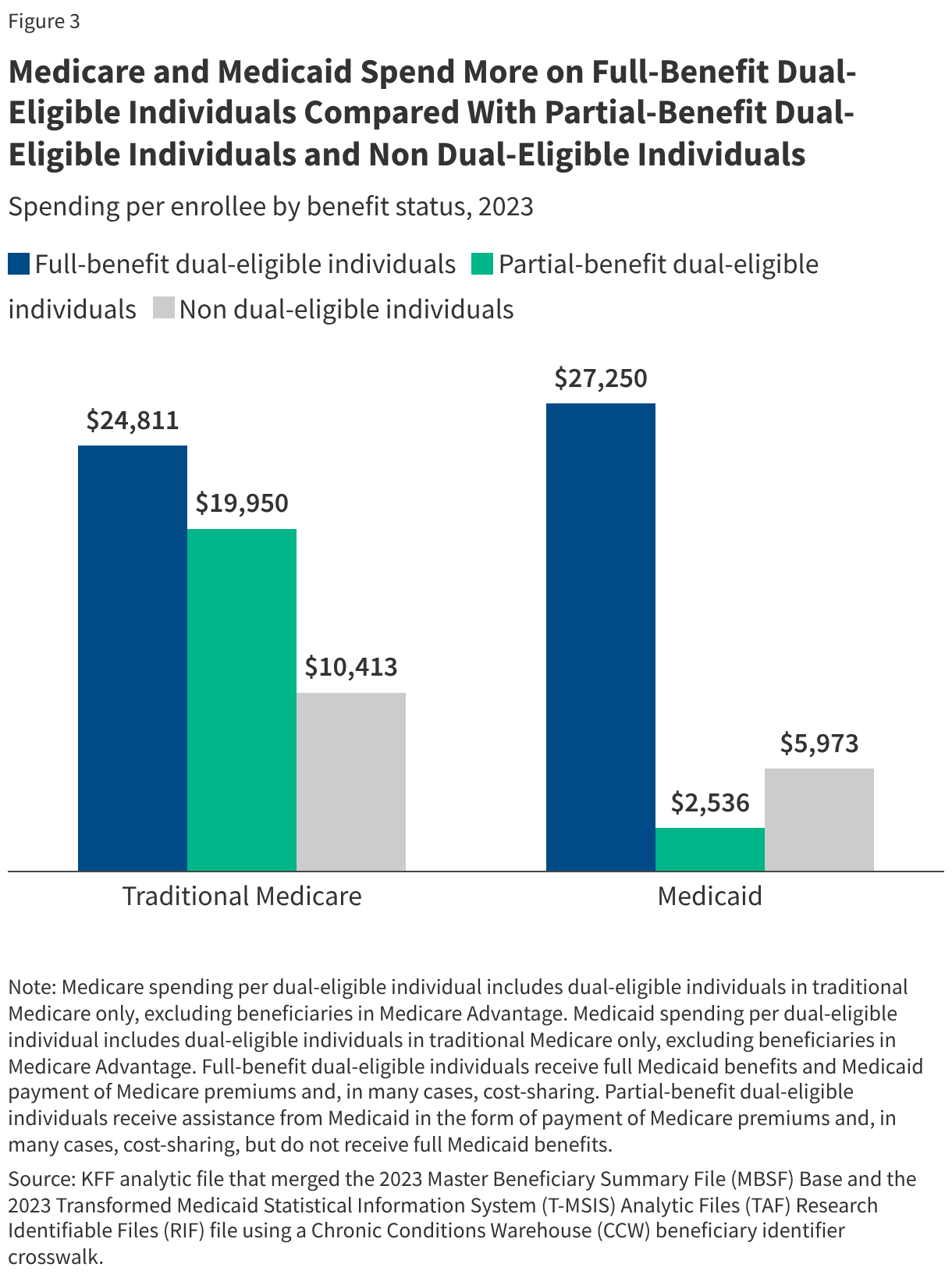
    3. Medicare and Medicaid spend more per person on full-benefit dual-eligible individuals compared with other enrollees.

    Traditional Medicare spending per person averages $24,811 for full-benefit dual-eligible individuals, $19,950 for partial-benefit dual-eligible individuals, and $10,413 for beneficiaries without Medicaid. Higher average Medicare per person spending among full-benefit dual-eligible individuals reflects greater use of medical care among this population, which could be related to their higher rates of chronic conditions (see below). Higher Medicare spending among full-benefit dual-eligible individuals may also reflect their ability to access health care services without substantial financial barriers associated with cost sharing, since most full-benefit dual-eligible individuals receive Medicaid coverage of Medicare cost sharing. In addition, this group has access to certain Medicaid benefits, such as non-emergency medical transportation and case management, which could ease access barriers and increase use of Medicare-covered services.

    Per person Medicaid spending averages $27,250 for full-benefit dual-eligible individuals, $2,536 for partial-benefit dual-eligible individuals, and $5,973 for Medicaid enrollees without Medicare. Medicaid only pays for premiums and, in many cases, cost sharing for partial-benefit dual-eligible individuals. Even though Medicare is the primary payer for acute care, Medicaid per person spending for full-benefit dual-eligible individuals is several times larger than for Medicaid enrollees without Medicare. That difference likely reflects several factors: increased use of long-term care and other services not covered by Medicare; higher rates of chronic conditions among dual-eligible individuals, which is associated with higher spending (or greater use of services); and the fact that most other Medicaid enrollees are children, parents, and others under age 65 who tend to have lower per enrollee spending.

    Medicare and Medicaid Spend More on Full-Benefit Dual-Eligible Individuals Compared With Partial-Benefit Dual-Eligible Individuals and Non Dual-Eligible Individuals (Grouped column chart)

    4.  Full-benefit dual-eligible individuals have more chronic conditions than other people with Medicare or Medicaid.

    Rates of chronic conditions are higher among full-benefit and partial-benefit dual-eligible individuals compared with other people with Medicare or Medicaid coverage. Fifty seven percent of full-benefit and 56% of partial-benefit dual-eligible individuals have five or more chronic conditions, compared with less than half (47%) of all other Medicare beneficiaries and just 2% of enrollees with Medicaid only. The relatively high rates of Medicare beneficiaries with multiple chronic conditions reflects that the Medicare population consists primarily of adults ages 65 and older, where chronic conditions such as hypertension, hyperlipidemia, and arthritis are more common than among younger adults. Medicaid-only enrollees are less likely than dual-eligible individuals to have chronic conditions, which reflects the fact that most Medicaid enrollees are children, parents, and others under age 65. Nearly two-thirds of Medicaid-only enrollees (64%) have no chronic conditions, compared with 17% of non-dual Medicare beneficiaries, and just 8% of full- and 9% of partial-benefit dual-eligible individuals.
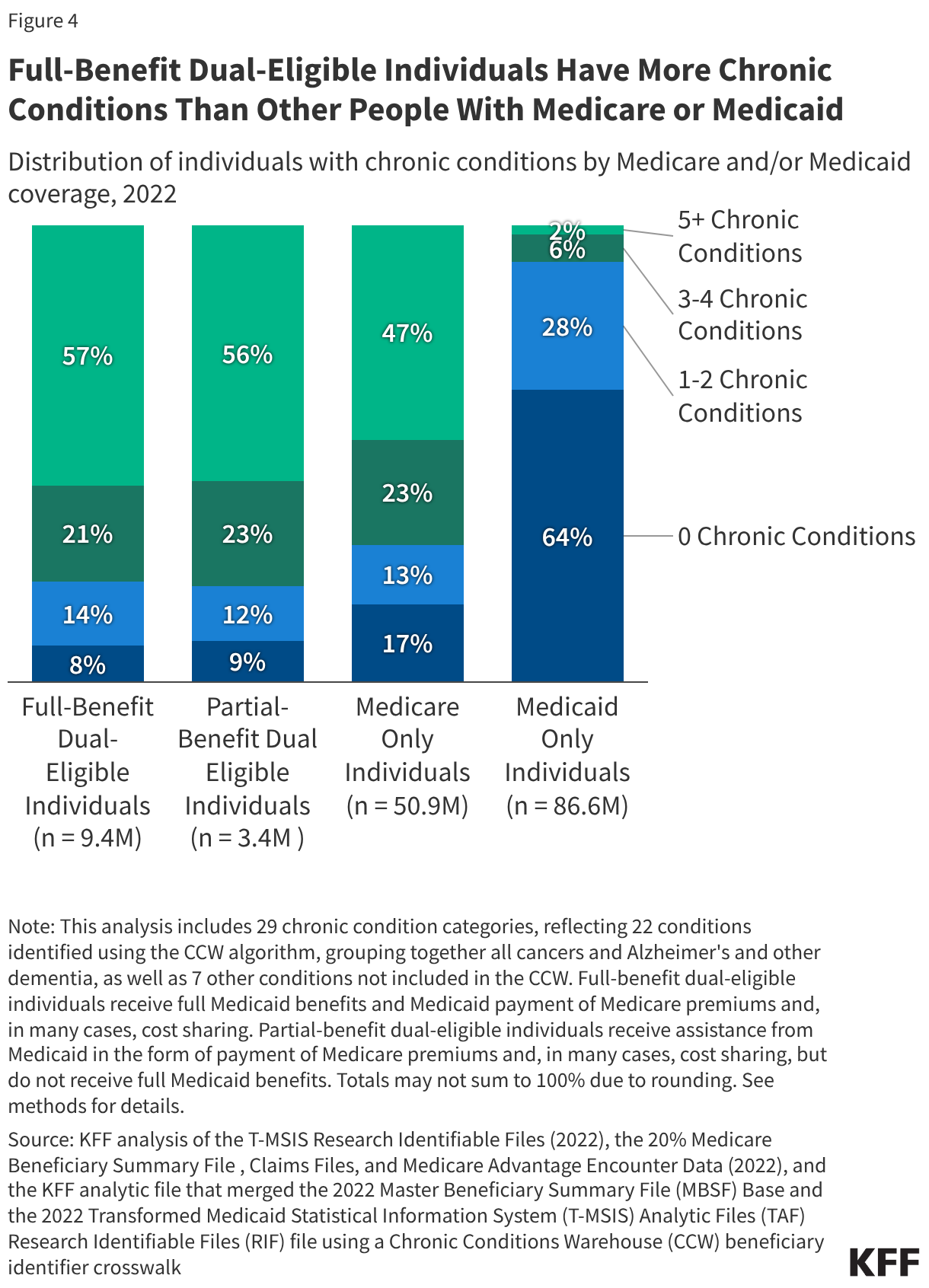

    Full-Benefit Dual-Eligible Individuals Have More Chronic Conditions Than Other People With Medicare or Medicaid (Stacked column chart)

    5.  Among full-benefit dual-eligible individuals with traditional Medicare, Medicare and Medicaid spending increase with the number of chronic conditions.

    Among full-benefit dual-eligible individuals enrolled in traditional Medicare, Medicare and Medicaid spending increase with the number of chronic conditions. For a full-benefit dual-eligible individual without any chronic conditions, traditional Medicare spending averages $3,955 and Medicaid spending averages $4,751. In comparison, among those with five or more chronic conditions, traditional Medicare spending averages $40,341 (over 10 times higher) and Medicaid spending averages $27,681 (almost 6 times higher). Although Medicare is the primary payer for dual-eligible individuals’ acute care, Medicaid spending on dual-eligible individuals is often higher than that of Medicare. This outcome likely occurs because Medicare generally doesn’t cover long-term care, which can be extremely expensive, and accounts for nearly one-third of all Medicaid spending. Spending on Medicaid enrollees who use long-term care is eight times higher than that of enrollees who don’t use long-term care, and over 60% of enrollees who use long-term care are dual-eligible individuals.
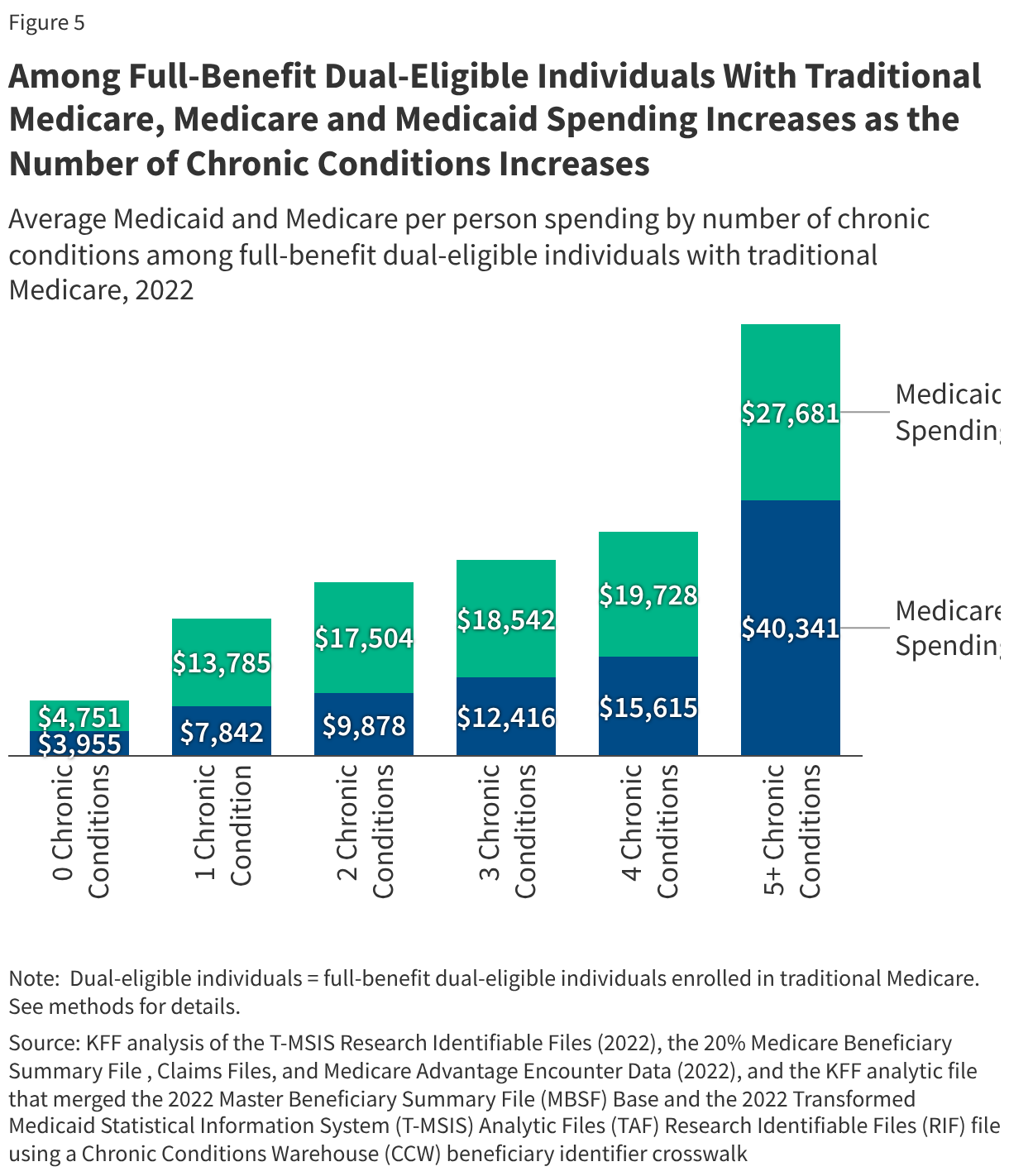

    Among Full-Benefit Dual-Eligible Individuals With Traditional Medicare, Medicare and Medicaid Spending Increases as the Number of Chronic Conditions Increases (Stacked column chart)

    This work was supported in part by Arnold Ventures. KFF maintains full editorial control over all of its policy analysis, polling, and journalism activities.

    Medicaid,Medicare,Chronic Diseases,Dual Eligible Individuals,EnrollmentChronic Diseases,Dual Eligible Individuals,Enrollment#Key #Facts #Spending #Enrollment #People #Medicare #Medicaid #DualEligible #Individuals1784140953

    Chronic Diseases Dual Eligible Individuals DualEligible Enrollment Facts Individuals key Medicaid Medicare People Spending
    admin
    • Website

    Related Posts

    Variability in Rebimbursement Rates for State Funded Abortion Services for Medicaid Enrollees: A 2026 Update

    August 7, 2026

    The Trump Administration’s Foreign Aid Review: Status of U.S. Support for Gavi, the Vaccine Alliance

    August 7, 2026

    The Trump Administration’s Foreign Aid Review: Status of the President’s Malaria Initiative (PMI)

    August 7, 2026

    Leave A Reply Cancel Reply

    Don't Miss
    Fitness

    Journalists Cover Cyclospora and Measles Outbreaks, and Changing Health Policies

    By adminAugust 8, 20260

    Céline Gounder, KFF Health News’ editor-at-large for public health, discussed the cyclosporiasis outbreak on CBS…

    Alarming Ebola Spread Raises Question of Viral Mutation

    August 7, 2026

    Variability in Rebimbursement Rates for State Funded Abortion Services for Medicaid Enrollees: A 2026 Update

    August 7, 2026

    Budget Battle Erupts in Nation’s Capital Over Opioid Settlement Money

    August 7, 2026
    Stay In Touch
    • Facebook
    • Twitter
    • Pinterest
    • Instagram
    • YouTube
    • Vimeo
    Our Picks

    Journalists Cover Cyclospora and Measles Outbreaks, and Changing Health Policies

    August 8, 2026

    Alarming Ebola Spread Raises Question of Viral Mutation

    August 7, 2026

    Variability in Rebimbursement Rates for State Funded Abortion Services for Medicaid Enrollees: A 2026 Update

    August 7, 2026

    Budget Battle Erupts in Nation’s Capital Over Opioid Settlement Money

    August 7, 2026

    Subscribe to Updates

    Get the latest creative news from SmartMag about art & design.

    Demo
    About Us
    About Us

    Your source for the lifestyle news. This demo is crafted specifically to exhibit the use of the theme as a lifestyle site. Visit our main page for more demos.

    We're accepting new partnerships right now.

    Email Us: info@example.com
    Contact: +1-320-0123-451

    Our Picks

    Large Study of COVID Vaccine Side Effects in Sweden

    January 12, 2020

    Coronavirus latest: Japan’s Vaccination Rate Tops 75% As Cases Drop

    January 10, 2020

    J&J’s New Vaccines Leader Talks Covid-19 & Pipeline Plans

    January 8, 2020

    Journalists Cover Cyclospora and Measles Outbreaks, and Changing Health Policies

    August 8, 2026

    Alarming Ebola Spread Raises Question of Viral Mutation

    August 7, 2026

    Variability in Rebimbursement Rates for State Funded Abortion Services for Medicaid Enrollees: A 2026 Update

    August 7, 2026
    Facebook Twitter Instagram Pinterest
    • Home
    • Health
    • Nutrition
    • News
    © 2026 ThemeSphere. Designed by WPfastworld

    Type above and press Enter to search. Press Esc to cancel.