


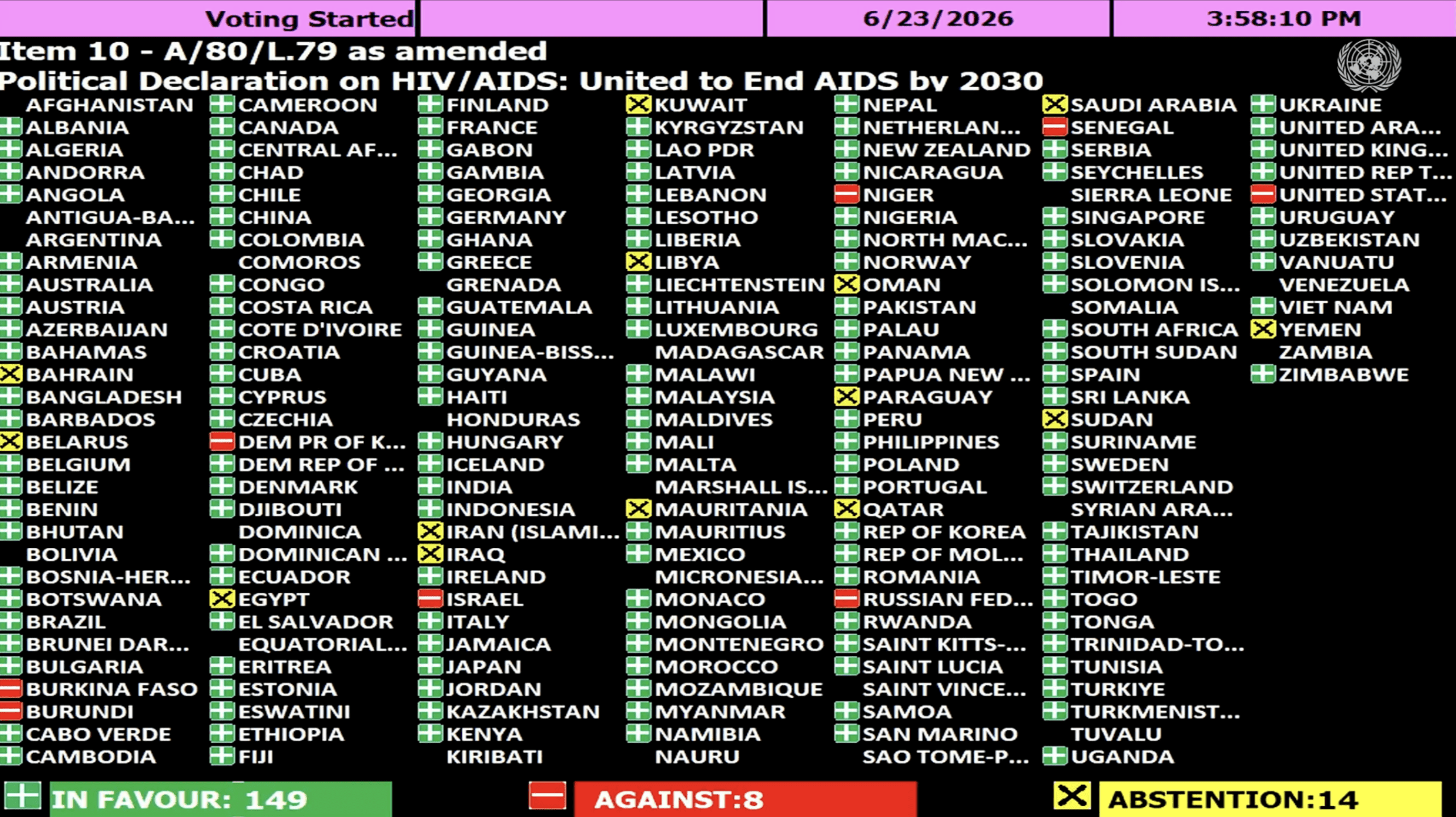

The United States and Russia were part of a group of eight countries that voted against the United Nations (UN) Political Declaration on HIV/AIDS, which was adopted by 149 votes at the High-Level Meeting (HLM) on Tuesday afternoon.
Israel, Burkina Faso, Burundi, North Korea, Niger and Senegal also voted against the declaration, while there were 14 abstentions, including nine from countries in the Middle East.
US Ambassador Tammy Bruce said that the declaration diverged from the 95-95-95 targets “by including divisive topics, reaffirming documents that do not enjoy consensus or which are not related to the fight against AIDS”.
The UN adopted the 95-95-95 targets, in 2021 which involve ensuring that 95% of people with HIV know their status; 95% of people with HIV are on antiretroviral (ARV) treatment, and 95% of those on ARVs are virally suppressed.
Bruce also recorded “deep concern” that the declaration included issues related to trade – a reference to clauses encouraging the transfer of technology to countries to enable them to produce their own HIV treatment.
“We have made clear our longstanding position on intellectual property protection and the need for transfer of technology to be on both voluntary and mutually agreed terms. We cannot accept references without appropriate caveats,” said Bruce.

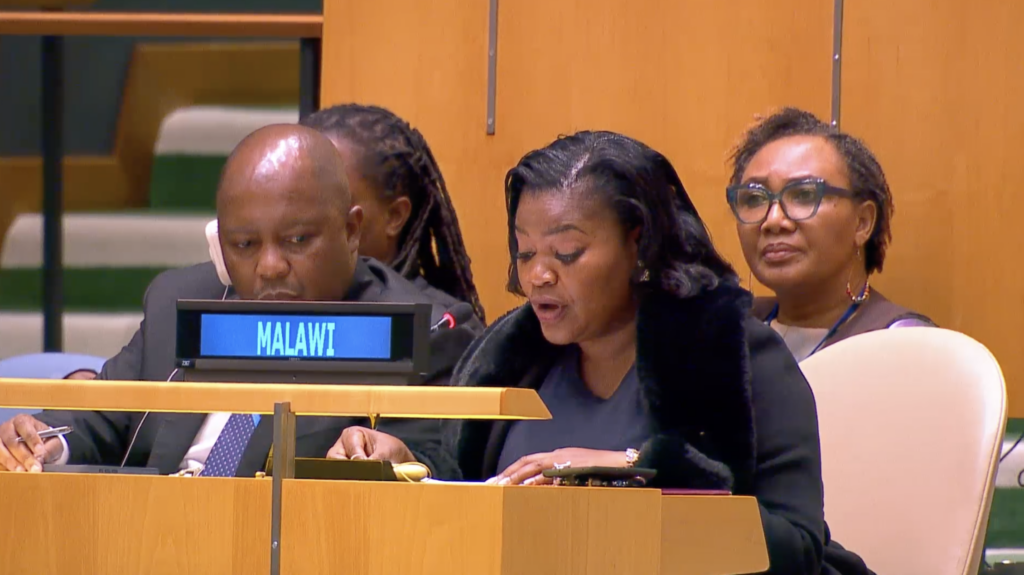
A last-minute oral amendment to the declaration by Malawi, on behalf of the Africa Group, removed the phrase “mutually agreed terms” in relation to technology transfer. This also incurred the disapproval of Switzerland and Canada, which dissociated their countries from these paragraphs.
However, Malawi’s Madalitso Baloyi said: “The African group believes that keeping ‘on mutually agreed terms’ in the text in connection to technology transfer undermines the key objective to access medicines, vaccines, and medical products, and to boost research and development”.
The Africa Group has advanced the same argument during negotiations for a Pandemic Agreement, arguing that pharmaceutical companies need to be compelled to share technology during health emergencies.
Israel also cited the inclusion of trade issues in the 15-page declaration as one of the reasons for its vote against, but also launched a diatribe against a reference to the 2016 Durban Declaration on HIV – which it accused of being “anti-Semitic” without basis.
‘Dubious notions’
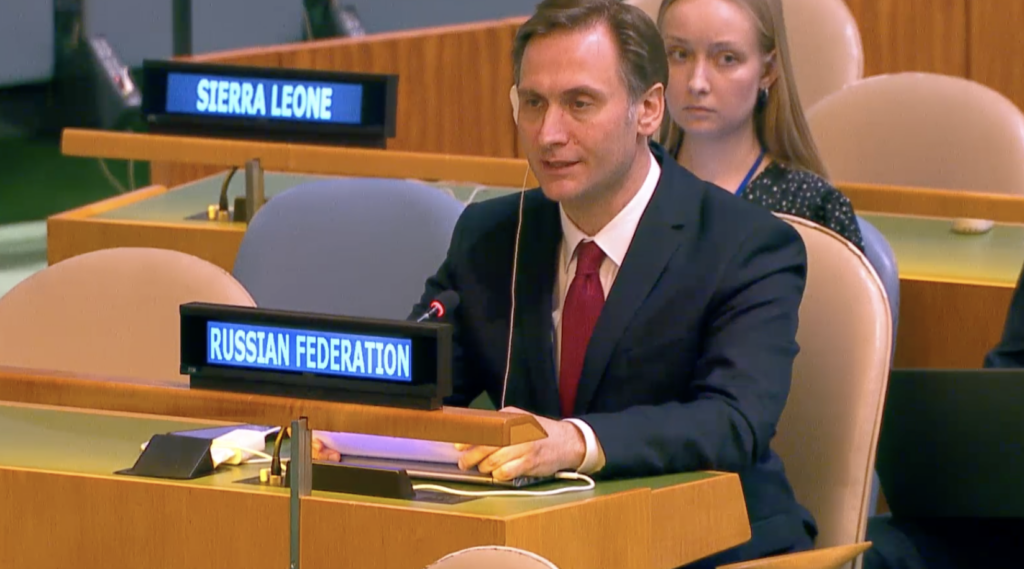
Meanwhile, Russia cited “at least 20 unacceptable provisions linked to intervention in domestic affairs of member states in combating the spread of HIV infections, imposing upon countries scientifically dubious notions”.
The declaration notes “the lack of significant progress in expanding harm reduction programmes”, and calls out “discrimination against people who use drugs, particularly those who inject drugs, through the application of restrictive laws”.
HIV in Russia is comparatively high in people who inject drugs, but Russia supports criminalisation rather than harm reduction.
Russia also accused the declaration of “the promotion of non-consensus-based language on gender”. This view was echoed by Belarus, Burundi and Senegal.
‘Key populations’
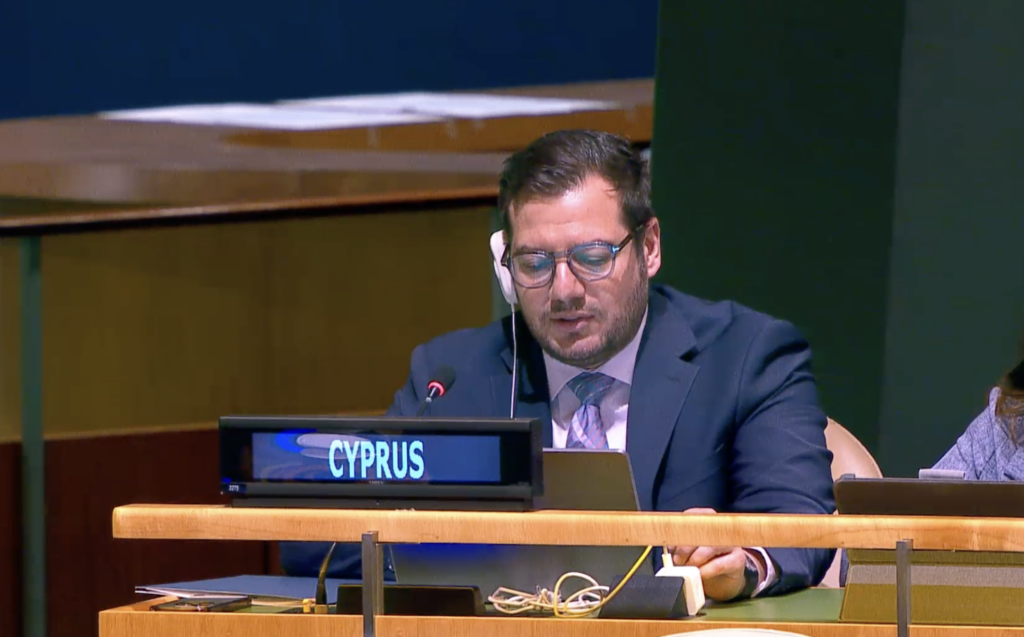
Cyprus, on behalf of the European Union, succeeded in amending the declaration to include the terms “sexual and reproductive health services”, “gender-based” in relation to violence” and “key populations” – a reference to groups that are most at risk of HIV. These differ per country, but traditionally include sex workers, gay men, young women, prisoners and people who inject drugs.
“Key populations face disproportionate stigma, discrimination, and violence barriers that severely hinder access to life-saving HIV services,” said Cyprus.
“Global evidence demonstrates that these groups face HIV prevalence rates up to 25 times higher than the general population, yet they continue to encounter barriers in accessing prevention, testing, diagnostic and treatment services.
“The European Union calls on all member states to uphold an evidence-based, inclusive, and rights-based HIV response and restore key populations to ensure no one is left behind in the fight against AIDS.”
While the declaration commits to ending HIV by 2039, it identifies several gaps, including “reductions in global financing for HIV and the impact of recent disruptions on HIV services”.
HIV prevention programmes are at “particular risk, including community-led services, as external funding contributed almost 80% of HIV prevention in sub-Saharan Africa, 66% in the Caribbean and 60% in the Middle East and North Africa in 2024”.
Meanwhile, “high debt servicing obligations and limited domestic fiscal capacity continue to constrain sustainable investments in health and HIV responses in certain countries”.
In 2024, the HIV response was short by $3.2 billion and “there is a risk that this funding gap will widen further due to recent, sharp reductions in HIV-related development assistance”, the declaration notes.
HIV remains a “public health emergency”, and infections increased between 2010 and 2025 in three regions, namely the Middle East and North Africa (by 77%), Latin America (13%), and Eastern Europe and Central Asia (15%), according to the declaration.
However, despite the declaration being carried by a huge majority, several countries said that the short negotiating period and length of the text had complicated negotiations, which were led by Botswana and Georgia.
Combat the infodemic in health information and support health policy reporting from the global South. Our growing network of journalists in Africa, Asia, Geneva and New York connect the dots between regional realities and the big global debates, with evidence-based, open access news and analysis. To make a personal or organisational contribution click here.
Africa,Content type,European Union,HIV and AIDS,Infectious Diseases,Institutions,News,Regional Policy,United Nations,AIDS,HIV,key populations,Malawi,Russia,UN High Level Meeting on HIV/AIDS,UNAIDS,US#Russia #Vote #Political #Declaration #HIV #AIDS1782261379
