


Summary
Actions taken by the Trump administration and Congress will likely have major impacts on health and health care for immigrant families, including reducing the number of lawfully present immigrants eligible for federally funded health coverage under the 2025 reconciliation law. While undocumented immigrants have already been ineligible for federally funded health coverage, the law newly limits Medicaid and Children’s Health Insurance Program (CHIP), subsidized Affordable Care Act (ACA) Marketplace, and Medicare coverage to lawfully present immigrants who are lawful permanent residents (LPRs) or green card holders, certain Cuban or Haitian immigrants, and people residing in the U.S. under Compacts of Free Association (COFA). As such, many lawfully present immigrants, including humanitarian immigrants, such as refugees and asylees, will become ineligible for coverage. However, the law does not eliminate optional Medicaid and CHIP coverage under the Immigrant Children’s Health Improvement Act (ICHIA) for lawfully residing children and pregnant people. This option allows a state to cover a broader group of lawfully present immigrants who meet income and other eligibility requirements. As such, ICHIA coverage could help mitigate potential coverage losses for lawfully present immigrant children and pregnant people.
This brief provides an overview of health coverage of noncitizen children based on KFF analysis of 2024 American Community Survey (ACS) data to provide greater insight into the potential role of ICHIA coverage in limiting the law’s impact on coverage for lawfully present immigrant children. While there are few noncitizen children in the U.S. overall, their access to health coverage has important implications for their health and well-being, including their long-term health and economic stability as adults. Although states can also use ICHIA to expand coverage for lawfully present immigrant pregnant people, this analysis does not include this group since they cannot be separately identified in ACS data. Similarly, the analysis includes all noncitizen children rather than just lawfully present immigrant children, because the data do not provide information on immigration status. However, separate research suggests there are very few undocumented children in the U.S. overall. Key takeaways include the following:
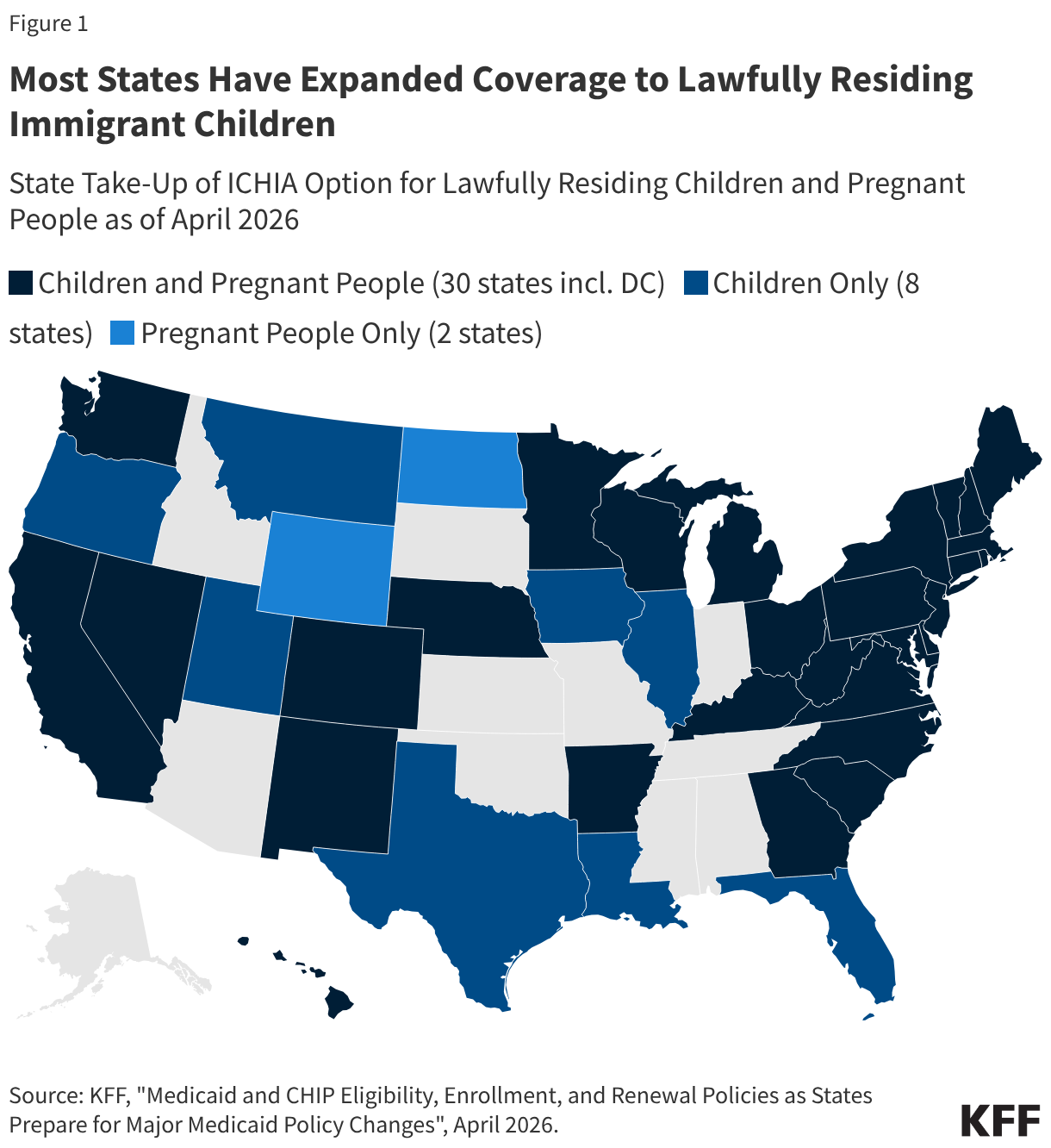
- As of April 2026, 38 states have implemented ICHIA coverage for lawfully residing immigrant children, and over nine in ten (92%) of the approximately 2.6 million noncitizen children in the U.S. live in a state with ICHIA coverage for children.
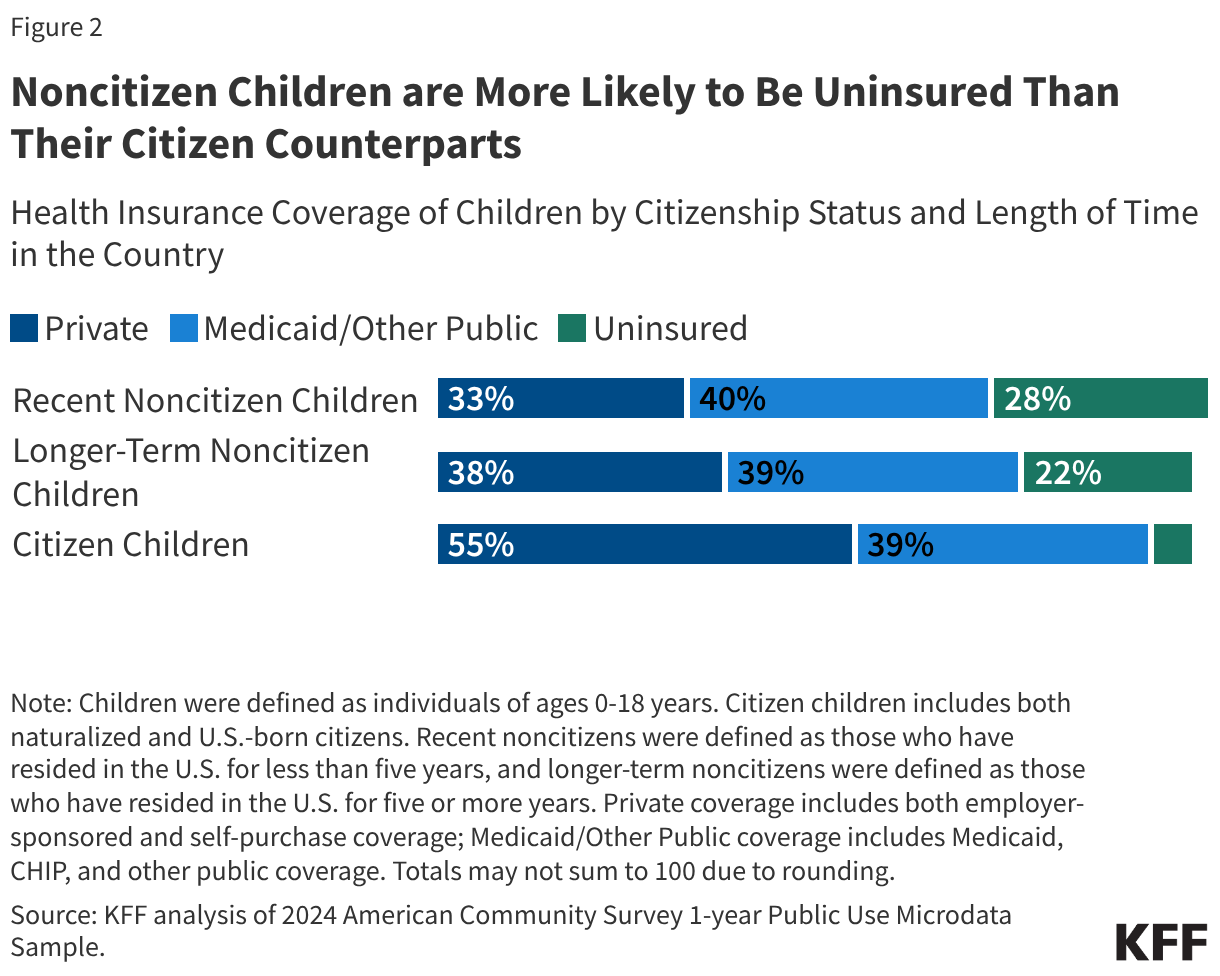
- Noncitizen children are more likely to be uninsured than citizen children. Recent noncitizen children in the U.S. for less than five years are at the highest risk of being uninsured, with 28% lacking coverage compared to 22% of their longer-term noncitizen counterparts and 5% of citizens.
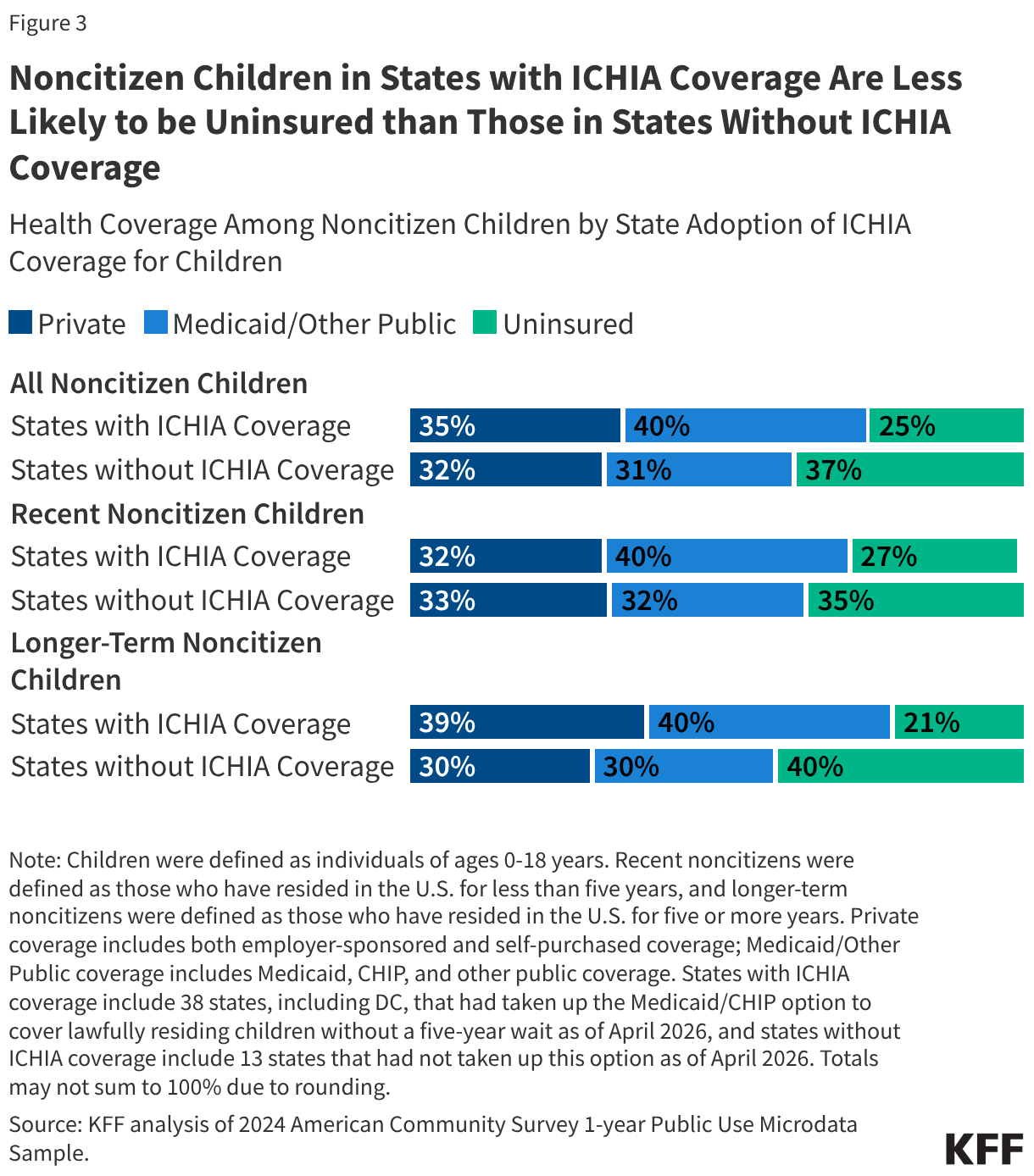
- The uninsured rate for noncitizen children living in states that have adopted ICHIA coverage for children is lower compared to the rate for noncitizen children living in states that have not (25% vs 37%), likely reflecting a combination of ICHIA coverage and other more expansive coverage policies in these states.
Together, the data show that Medicaid, CHIP, and other public coverage help reduce uninsured rates for noncitizen children, particularly recent noncitizen children living in ICHIA states. Maintaining ICHIA coverage could help mitigate coverage losses for lawfully present immigrant children as the 2025 reconciliation law eligibility restrictions go into effect. Additionally, implementation of ICHIA coverage in the states that have not yet adopted it or that have room to expand it for either children or pregnant people could further limit coverage losses. Even with ICHIA coverage in place, outreach and communication to families and effective processes to screen individuals for eligibility under the option will be important for preventing administrative coverage losses among those eligible as new restrictions are implemented.
Medicaid and CHIP Coverage Under the ICHIA Option
Prior to the 2025 reconciliation law, undocumented immigrants were already ineligible for Medicaid, CHIP, and other federally funded coverage, and lawfully present immigrants faced eligibility restrictions for Medicaid and CHIP. In 1996, the Personal Responsibility and Work Opportunity Reconciliation Act limited Medicaid and CHIP eligibility to certain groups of lawfully present immigrants deemed to have a “qualified status” and required many of these groups to wait at least five years before they could enroll even if they met other eligibility criteria (Table 1). As such, many lawfully present immigrants faced a five-year waiting period for coverage and others remained ineligible regardless of their length of time in the country, although some groups were exempt from the five-year waiting period. Lawfully present immigrants were eligible for ACA Marketplace coverage with subsidies to offset the cost of this coverage during their five-year waiting period for Medicaid or CHIP.
| Table 1: Lawfully Present Immigrants by Qualified Status | |
| Lawfully Present Immigrants With “Qualified Status” |
Lawfully Present Immigrants Without “Qualified Status” |
| • Lawful permanent resident (LPR or green card holder) • Refugee • Asylee • Cuban/Haitian entrant • Paroled into the U.S. for at least one year • Conditional entrant granted before 1980 • Granted withholding of deportation • Battered noncitizen, spouse, child, or parent • Victims of trafficking and their spouse, child, sibling, or parent or individuals with pending application for a victim of trafficking visa • Member of a federally recognized Indian tribe or American Indian born in Canada • Citizens of the Marshall Islands, Micronesia, and Palau who are living in one of the U.S. states or territories (referred to as Compact of Free Association or COFA migrants) |
• Granted Withholding of Deportation or Withholding of Removal, under the immigration laws or under the Convention against Torture (CAT) • Individual with Non-Immigrant Status, includes worker visas, student visas, U-visa, and other visas, and citizens of Micronesia, the Marshall Islands, and Palau • Temporary Protected Status (TPS) • Deferred Enforced Departure (DED) • Deferred Action Status • Lawful Temporary Resident • Administrative order staying removal issued by the Department of Homeland Security • Resident of American Samoa • Applicants for certain statuses • People with certain statuses who have employment authorization |
Since 2009, states have had the option to expand Medicaid and CHIP coverage for lawfully residing children and pregnant people under ICHIA. This option extends eligibility to lawfully residing children and/or pregnant people beyond those with “qualified status” and eliminates the five-year waiting period for coverage. As of April 2026, 38 states including DC have taken up this option for children and pregnant people or for children only and 2 states have taken it up for pregnant people only (Figure 1).Most states that have taken up ICHIA for children have taken up other coverage expansion options. These include options such as the ACA Medicaid expansion to low-income adults and fully state-funded coverage for certain groups of immigrants, such as children, regardless of immigration status (Appendix Table 1.)
Health Coverage Among Noncitizen Children
As of 2024, there were approximately 2.6 million noncitizen children ages 0 to 18 residing in the U.S. This includes 61% or 1.6 million who are recent noncitizen children in the U.S. for less than five years and 39% or 1 million who have been in the U.S for five or more years. This group includes both lawfully present and undocumented immigrants, although other research suggests there are very few undocumented children in the U.S. overall.
Noncitizen children are significantly more likely to be uninsured than their citizen counterparts (Figure 2). Recent noncitizen children are at the highest risk of being uninsured, with 28% lacking coverage compared to 22% of their longer-term noncitizen counterparts and 5% of citizens. The higher uninsured rate among noncitizen children reflects a lower rate of private coverage. Rates of public coverage for children are similar across citizenship status and length of time in the country. However, noncitizen children are more likely than their citizen counterparts to live in a low-income family and, therefore, are more likely to be eligible for public coverage yet enrolled at lower rates.
The uninsured rate for noncitizen children is significantly lower in states that have adopted the ICHIA option for children compared to the rate for noncitizen children in states that have not adopted this option (25% vs. 37%). This pattern holds true across both recent noncitizen children (27% vs. 35%) as well as longer-term noncitizen children (21% vs. 40%). The lower uninsured rate in these states is largely driven by higher rates of public coverage, particularly among recent noncitizen children. This likely reflects the expanded coverage to recent lawfully residing immigrant children who would otherwise be in the five-year waiting period as well as broader groups of lawfully residing immigrant children who do not have “qualified status.” Additionally, as noted, some of these states have implemented other coverage expansions for immigrant children, such as fully state-funded programs, as well as broader expansions for the low-income population, including the ACA Medicaid expansion to low-income adults, which may have spillover effects on children’s coverage. States with ICHIA coverage for children also cover a much larger number of noncitizen children than states without ICHIA, as over nine in ten (92%) of noncitizen children live in these 38 states.
ICHIA Coverage Under the 2025 Reconciliation Law
The 2025 reconciliation law limits eligibility for federally funded coverage, including Medicaid, CHIP, subsidized ACA Marketplace, and Medicare coverage, to LPRs (green card holders), certain Cuban and Haitian entrants, and people residing in the U.S. under COFA. This change eliminates eligibility for many groups of lawfully present immigrants such as refugees, U visa holders and applicants, and people with Temporary Protected Status, and is expected to lead to 1.4 million lawfully present immigrants becoming uninsured by 2034. The Medicaid and CHIP eligibility restrictions will take effect as of October 1, 2026, and are expected to lead to 100,000 individuals becoming uninsured by 2034.
The 2025 reconciliation law did not eliminate optional Medicaid and CHIP coverage for lawfully residing children and/or pregnant people under ICHIA. ICHIA coverage provides eligibility for a broader group of lawfully present immigrants in these groups who would otherwise no longer be eligible under the reconciliation law and also extends eligibility to recent immigrants who would otherwise be subject to the five-year waiting period for Medicaid and CHIP.
States could mitigate coverage losses for lawfully present immigrant children and pregnant people by maintaining or expanding ICHIA coverage. Overall, 11 states have not taken up ICHIA coverage for either children or pregnant people, 8 states have taken up the option for children but could expand it to pregnant people, and 2 states have taken up the option for pregnant people only but could expand it to children. Conversely, elimination of ICHIA coverage could exacerbate coverage losses for these groups. Some states facing budget pressures have recently cut back on state-funded coverage for immigrants. While no state has eliminated ICHIA coverage to date, states continue to face increasing budget pressures. ICHIA cannot mitigate coverage losses among non-pregnant adults who will no longer be eligible for Medicaid based on their immigration status.
Even with ICHIA coverage in place, outreach and education to families and effective eligibility screening processes will be important to prevent administrative losses among those still eligible as the reconciliation law changes are implemented. For example, as states implement new eligibility restrictions, it will be important to effectively screen people for eligibility under the ICHIA option to make sure they do not lose coverage if they are still eligible. Families may also be confused about shifting eligibility rules, which may be compounded by confusion and fears stemming from recent changes to public charge policies. Additionally, a couple of states almost inadvertently eliminated this coverage through state legislation to implement the 2025 reconciliation law, although these changes were eventually avoided.
Methods
Data sources: This brief is based on KFF analysis of federal survey data, namely the American Community Survey 1-year Public Use Microdata Sample. The ACS is a nationally representative household survey conducted by the U.S. Census Bureau. ACS PUMS data are available on a yearly basis. State-level data on immigrant subpopulations were excluded due to sample size.
Identifying citizenship status: U.S. citizens were defined as naturalized citizens or U.S.-born citizens. Naturalized citizens are individuals who indicate becoming a U.S. citizen by naturalization. Noncitizen immigrants are individuals who say that they are not a U.S. citizen, including both lawfully present and undocumented immigrants.
Defining insurance coverage categories: Private insurance coverage included employer-sponsored and direct purchase insurance plans. Public insurance coverage included Medicare, Medicaid, and military-sponsored insurance plans.
Defining state take-up of ICHIA: Information on state take-up of ICHIA is based on KFF and Georgetown University’s 2026 Medicaid Eligibility and Enrollment Survey. For the purposes of this analysis, the 38 states that have taken up ICHIA for lawfully residing children were grouped into “States with ICHIA Coverage” for children.
| Appendix Table 1: State Take-Up of Health Coverage Expansions | ||||||
| State | ICHIA Option | ACA Medicaid Expansion | FCEP Option | State-Funded Coverage | ||
| Children | Pregnant People | Children or Pregnant People | Adults | |||
| States That Have Adopted ICHIA Coverage for Children | ||||||
| Arkansas | Yes | Yes | Yes | Yes | No | No |
| California | Yes | Yes | Yes | Yes | Yes | Yes |
| Colorado | Yes | Yes | Yes | Yes | Yes | Yes |
| Connecticut | Yes | Yes | Yes | Yes | Yes | No |
| Delaware | Yes | Yes | Yes | No | No | No |
| District of Columbia | Yes | Yes | Yes | Yes | Yes | Yes |
| Florida | Yes | No | No | No | No | No |
| Georgia | Yes | Yes | No | No | No | No |
| Hawaii | Yes | Yes | Yes | No | No | No |
| Illinois | Yes | No | Yes | Yes | Yes | Yes |
| Iowa | Yes | No | Yes | No | No | No |
| Kentucky | Yes | Yes | Yes | No | No | No |
| Louisiana | Yes | No | Yes | Yes | No | No |
| Maine | Yes | Yes | Yes | Yes | Yes | No |
| Maryland | Yes | Yes | Yes | Yes | No | No |
| Massachusetts | Yes | Yes | Yes | Yes | Yes | No |
| Michigan | Yes | Yes | Yes | Yes | No | No |
| Minnesota | Yes | Yes | Yes | Yes | Yes | No |
| Montana | Yes | No | Yes | No | No | No |
| Nebraska | Yes | Yes | Yes | Yes | No | No |
| Nevada | Yes | Yes | Yes | No | No | No |
| New Hampshire | Yes | Yes | Yes | No | No | No |
| New Jersey | Yes | Yes | Yes | No | Yes | No |
| New Mexico | Yes | Yes | Yes | No | No | No |
| New York | Yes | Yes | Yes | Yes | Yes | Yes* |
| North Carolina | Yes | Yes | Yes | No | No | No |
| Ohio | Yes | Yes | Yes | No | No | No |
| Oregon | Yes | No | Yes | Yes | Yes | Yes |
| Pennsylvania | Yes | Yes | Yes | No | No | No |
| Rhode Island | Yes | Yes | Yes | Yes | Yes | No |
| South Carolina | Yes | Yes | No | No | No | No |
| Texas | Yes | No | No | Yes | No | No |
| Utah | Yes | No | Yes | No | Yes | No |
| Vermont | Yes | Yes | Yes | No | Yes | No |
| Virginia | Yes | Yes | Yes | Yes | No | No |
| Washington | Yes | Yes | Yes | Yes | Yes | Yes |
| West Virginia | Yes | Yes | Yes | No | No | No |
| Wisconsin | Yes | Yes | No | Yes | No | No |
| States that Have Not Adopted ICHIA Coverage for Children | ||||||
| Alabama | No | No | No | Yes | No | No |
| Alaska | No | No | Yes | No | No | No |
| Arizona | No | No | Yes | No | No | No |
| Idaho | No | No | Yes | No | No | No |
| Indiana | No | No | Yes | No | No | No |
| Kansas | No | No | No | No | No | No |
| Mississippi | No | No | No | No | No | No |
| Missouri | No | No | Yes | Yes | No | No |
| North Dakota | No | Yes | Yes | No | No | No |
| Oklahoma | No | No | Yes | Yes | No | No |
| South Dakota | No | No | Yes | Yes | No | No |
| Tennessee | No | No | No | Yes | No | No |
| Wyoming | No | Yes | No | No | No | No |
| Note: “ICHIA Option” for children or pregnant people includes states that implement ICHIA for these populations as of January 2026. “Medicaid Expansion” includes states that have adopted the Affordable Care Act’s (ACA) expanded Medicaid coverage to nearly all adults with incomes up to 138% of the Federal Poverty Level as of May 2026. “FCEP Option” includes states that adopted the CHIP From-Conception-to-End-of-Pregnancy (FCEP) option. “State-Funded” includes states that provide any state-funded health coverage to income-eligible adults or children regardless of immigration status as of April 2026. State-funded coverage for adults in New York is limited to individuals 65 or older. | ||||||
| Source: KFF/Georgetown University, 2026 Medicaid Eligibility and Enrollment Survey (April 2026); KFF, “Status of State Medicaid Expansion Decisions” (May 2026); KFF, “Medicaid and CHIP Income Eligibility Limits for Pregnant Women as a Percent of the Federal Poverty Level” (January 2026); KFF, “State Health Coverage for Immigrants and Implications for Health Coverage and Care” (May 2026). | ||||||
Immigrant Health,Medicaid,Racial Equity and Health Policy,Access to Care,Adolescents,Children,Children’s Health Insurance Program (CHIP),Eligibility,Maternal and Child HealthAccess to Care,Adolescents,Children,Children’s Health Insurance Program (CHIP),Eligibility,Maternal and Child Health#Optional #Medicaid #CHIP #Coverage #Lawfully #Present #Immigrant #Children #Mitigate #Coverage #Losses #Due #Reconciliation #Law1786709661
