


Highlights
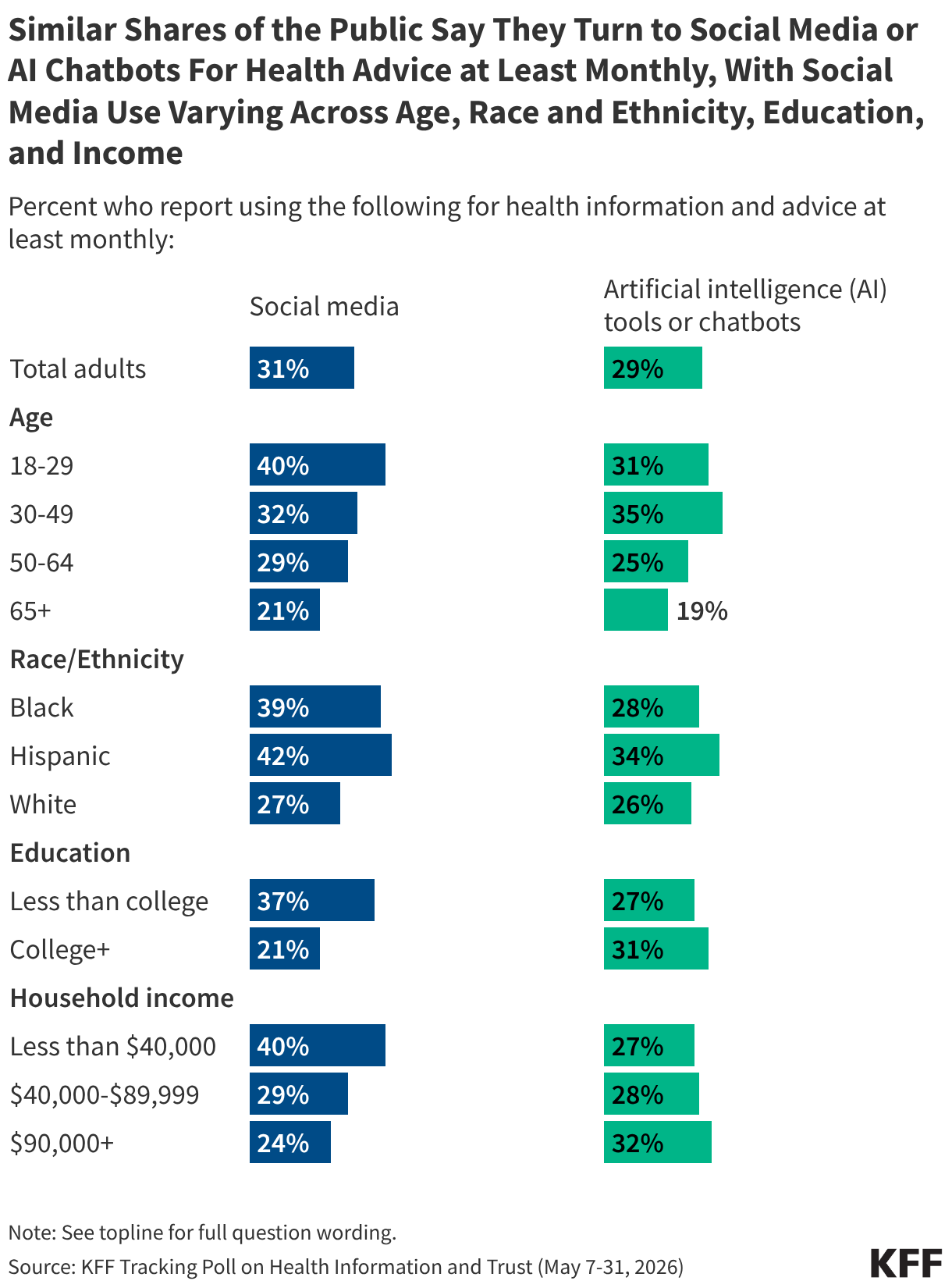
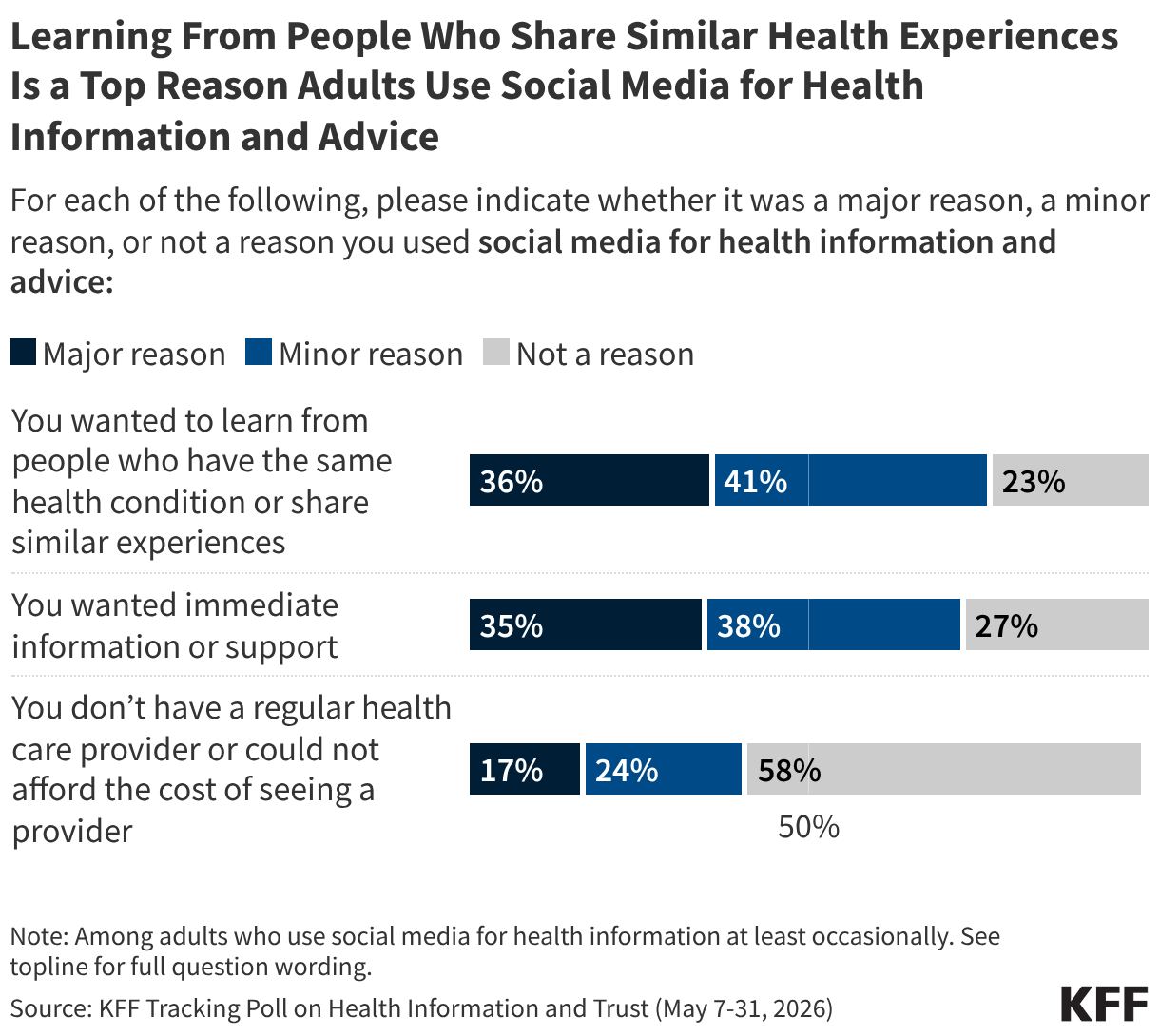
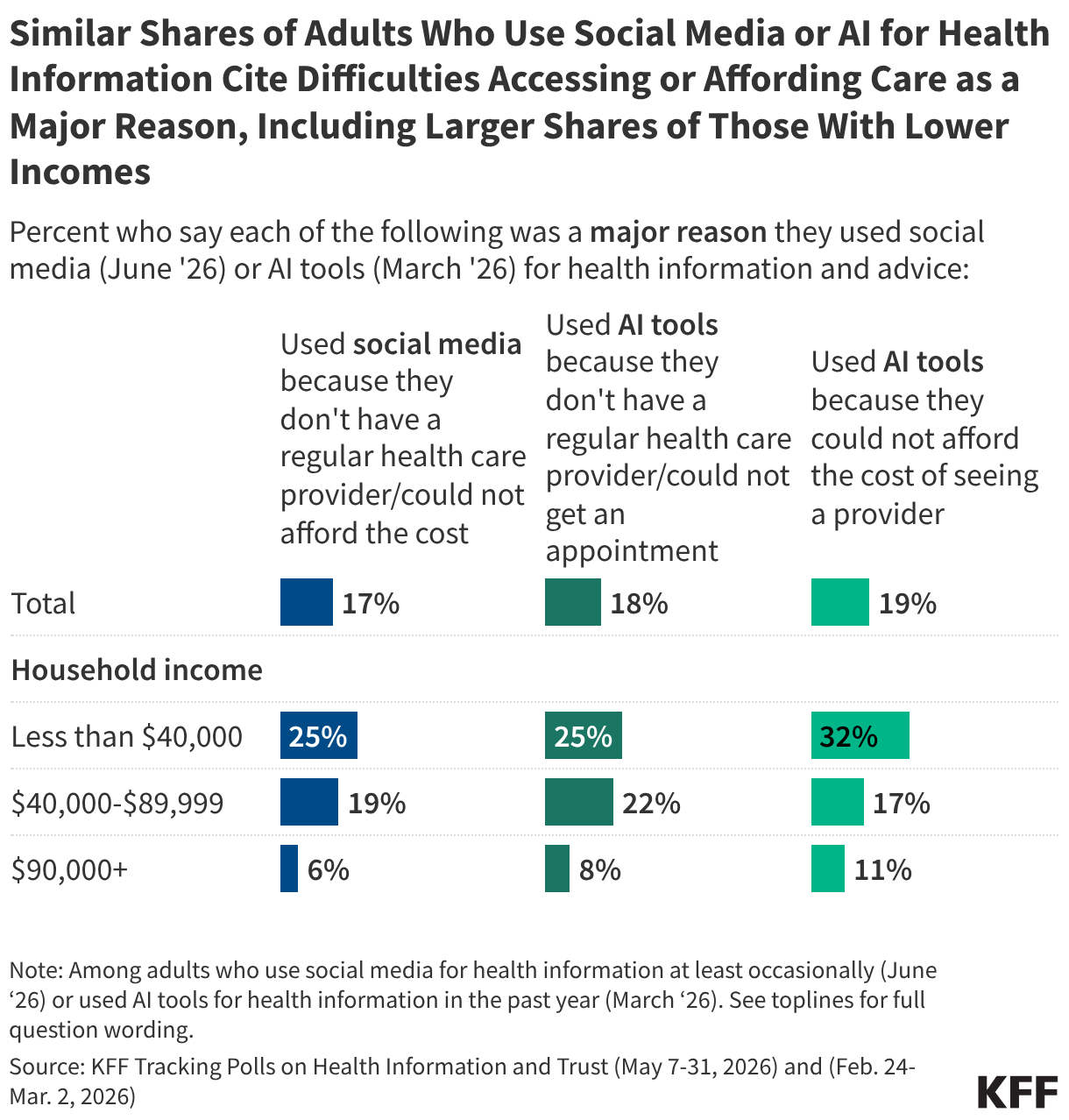
The latest KFF Tracking Poll on Health Information and Trust finds roughly three in ten adults report turning to social media (31%) or AI chatbots (29%) at least monthly for health information and advice. The top reasons people report turning to social media for health advice are wanting to hear from those with similar experiences or a desire for quick information. But nearly one in five say they turned to social media due to difficulties accessing or affording care, similar to the shares who cited access and cost as reasons for turning to AI for health information in a previous KFF poll.
These findings as well as data from dozens of past KFF polls can also be found on KFF’s Health Information and Trust Polling Dashboard.
Featured
KFF Poll Shows Three in Ten Adults Regularly Turn to Social Media or AI For Health Advice, With Similar Shares of Social Media and AI Users Citing Barriers to Accessing Care as a Reason for Using These Platforms
KFF’s latest Tracking Poll on Health Information and Trust examines the public’s use of social media and AI for health information. Overall, three in ten (31%) adults say they use social media at least monthly for health information and advice, similar to the share (29%) who say they use artificial intelligence (AI) tools or chatbots at least monthly for health. Larger shares of adults under 30, Black and Hispanic adults, those without a college degree, and those with lower incomes say they turn to social media for health information at least monthly.
Among people who use social media for health information at least occasionally, over a third say a “major reason” they did so was to learn from others with similar experiences or conditions (36%) or because they wanted immediate information or support (35%). A smaller share of users (17%) say a “major reason” they relied on social media was because they don’t have a health care provider or couldn’t afford to see one.
While cost and access problems may not be the top reason people turn to either social media or AI for health information, nearly one in five users are turning to each of these mediums for these reasons, including even higher shares among those with lower incomes. Among adults who use social media for health, this reason is also more commonly cited among uninsured adults (32%) and some groups that have historically had a harder time accessing health care, including Hispanic adults (29%) and LGBT adults (30%).
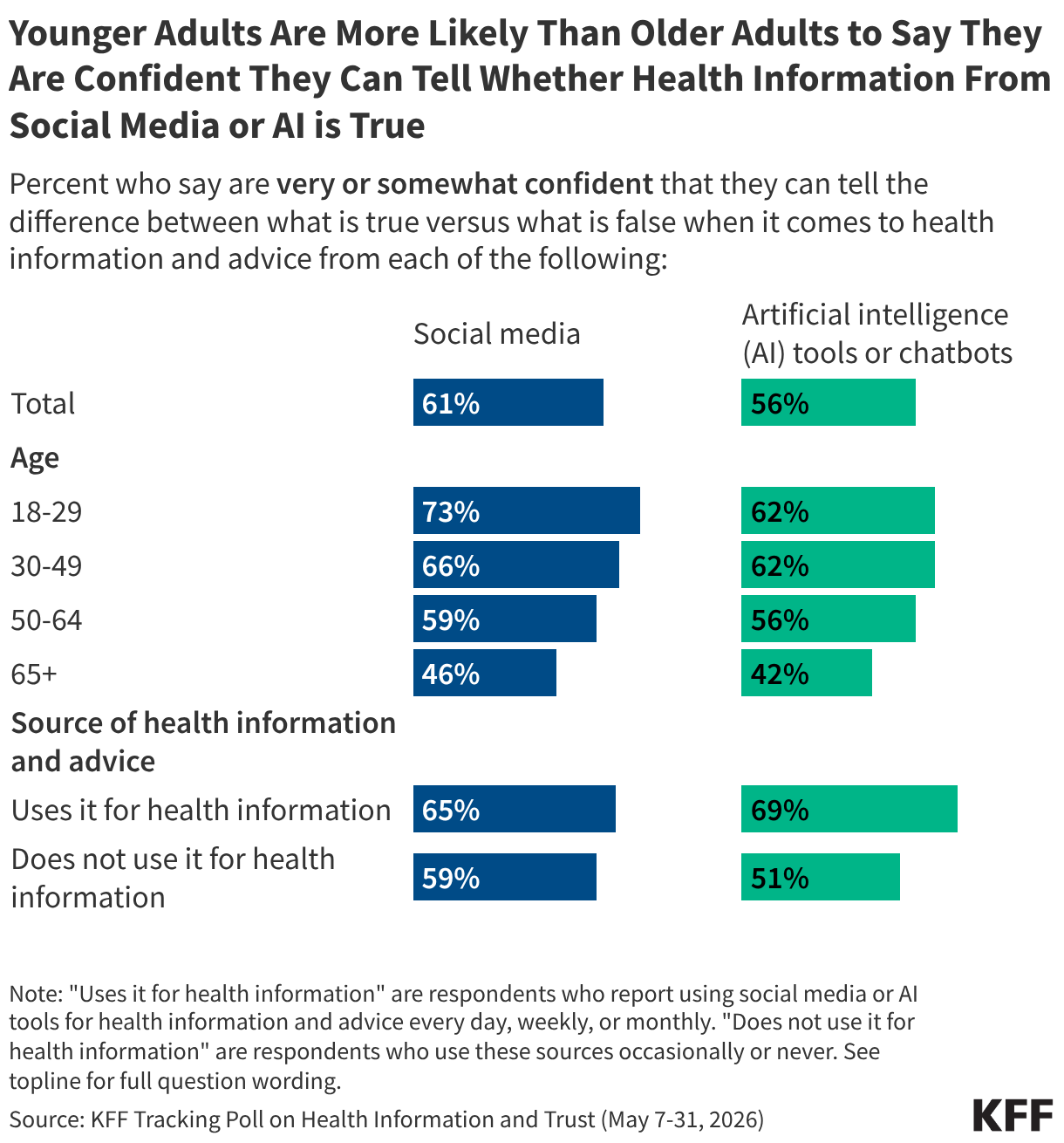
While a slim majority of adults express confidence in their ability to tell whether health information from social media or AI tools is true or not, about four in ten lack confidence in this regard. Adults who use social media and AI for health information are more likely than those who don’t to express confidence in their ability to discern whether health information on these platforms is true or not, as are younger adults compared to older adults.
AI & Emerging Tech
Understanding the Role of AI in Spreading and Creating Faulty Research
- A correspondence published in The Lancet in May identified more than 4,000 fabricated references across nearly 2.5 million biomedical papers published between 2023 and early 2026. Researchers found that papers containing at least one fabricated citation became substantially more common during the study period, rising from roughly one in 2,800 papers in 2023 to one in 277 papers in early 2026. Many of the fabricated references appeared legitimate, citing real researchers, plausible publication years, and topic-specific article titles, but pointed to studies that did not exist.
- The authors note that large language models (LLMs) are known to generate fabricated citations that appear authentic, and that the sharp rise in fabricated references coincided with the period following widespread adoption of generative AI tools. While the study could not determine what caused the increase, researchers note that fabricated references can emerge through multiple pathways, including AI-generated citations, paper mills, and other forms of research misconduct.
Here’s the big picture:
- AI systems can amplify inaccurate or fabricated information. Large language models sometimes generate information that sounds plausible but is unsupported or entirely false, a phenomenon often referred to as “hallucination.” A 2025 study found that when fictional medical terms were included in health questions, chatbots elaborated on them in nearly two-thirds of cases, generating explanations and treatments for conditions that do not exist. Researchers demonstrated a similar dynamic in an experiment involving a fictional skin condition called “bixonimania.” After uploading fake papers about the condition to a preprint server, they found that several major AI chatbots described the made-up disorder as real and, in some cases, recommended medical care. The fabricated papers were later cited in a peer-reviewed article before being retracted.
- AI systems increasingly interact with scientific literature that contain fraudulent or unreliable research. Researchers have documented the growing presence of “paper mills,” operations that produce and sell fraudulent academic manuscripts. A study in BMJ found that nearly 10% of cancer research papers showed signs of paper mill involvement, with the proportion increasing over time. Because AI systems are trained on large volumes of publicly available content, including scientific literature, concerns have emerged that low-quality or fraudulent research may influence the information these systems retrieve, summarize, or generate. Some research has shown that even when fraudulent papers make up just 0.01% of an AI system’s training data, they can contribute to errors in as many as 10% of responses.
- Generative AI is also lowering barriers to producing convincing scientific content. Researchers have identified AI-generated manuscripts circulating through academic publishing and scholarly databases, sometimes without disclosure of AI assistance. The ability to rapidly generate text, references, and literature reviews raises concerns that AI could accelerate the production of papers that appear credible but contain errors, unsupported claims, or fabricated citations. As a result, some researchers and publishers are calling for stronger screening, reference verification, and disclosure requirements throughout the publication process.
Why This Matters: AI is increasingly involved at multiple stages of the scientific information ecosystem, from generating content and citations to retrieving and summarizing published research. As fabricated references, fraudulent papers, and other forms of low-quality research become harder to distinguish from legitimate scholarship, weaknesses in one part of the system can affect others. New efforts to detect paper mills, verify references, and improve AI reliability are underway, but people are already using AI tools to answer health questions.
What We’re Watching
A Closer Look at the State Level: New Jersey Poll Finds Broad Concern About Misinformation, Alongside Use of Search and Social Platforms
A Rutgers-Eagleton Poll commissioned by the New Jersey Civic Information Consortium found that concerns about misinformation are widespread among New Jersey voters, with 60% describing the spread of false or misleading information as a “very big problem” and another 22% calling it a “moderately big problem.” The survey also found that New Jerseyans frequently rely on digital channels for news, including search engines (77%), friends and family (75%), and national news outlets (71%). At the same time, about one-third of voters (34%) said local news coverage in their area has decreased over the past five years. Rutgers researchers noted that concern about misinformation was shared across demographic and political groups, suggesting a rare point of bipartisan agreement.
Why This Matters: The findings are consistent with 2023 KFF polling among the general public, which found that a vast majority of adults (83%) say the spread of false and inaccurate information in the United States is a “major problem.” At the same time, the Rutgers-Eagleton survey sheds light on the role that search engines, social networks, and interpersonal connections play in how people access information and evaluate its credibility.
Health Information and Trust,Artificial Intelligence,Social MediaArtificial Intelligence,Social Media#KFF #Poll #Shows #ThreeinTen #Adults #Turn #Social #Media #Health #Information #LowerIncome #Adults #CiteCost #Access #Barriersasa #Reason #Monitor1782390333
