

Subscribe to Updates

    Get the latest creative news from FooBar about art, design and business.

    What's Hot

    Journalists Dig Into HHS’ Covid Injury List, ACA Sign-Ups, and Telehealth

    July 18, 2026

    Pandemic Talks Consider Two Opposing Models for Pathogen Sharing

    July 17, 2026

    Unitaid’s Opaque Leadership Search Advances Amid Plunging Budgets, Calls for Reform

    July 17, 2026
    Facebook Twitter Instagram
    Health Care Providers & FacilitiesHealth Care Providers & Facilities
    • Health
    • Nutrition
    Facebook Twitter Instagram
    SUBSCRIBE
    • Homepage
    • Health

      KFF Tracker: U.S. Global Health Programs by Country and Region

      July 16, 2026

      A Closer Look at Deficiencies in Nursing Homes

      July 16, 2026

      Poll: Costs Are the Top Health Care Issue for Voters in the Midterms, But Fraud Tops Republicans’ List As Trump Administration Pushes Crackdown

      July 16, 2026

      KFF Health Tracking Poll: Public Views on Fraud in Government Health Programs

      July 16, 2026

      Medicaid Postpartum Coverage Extension Tracker

      July 15, 2026
    • News
      1. Health
      2. View All

      KFF Tracker: U.S. Global Health Programs by Country and Region

      July 16, 2026

      A Closer Look at Deficiencies in Nursing Homes

      July 16, 2026

      Poll: Costs Are the Top Health Care Issue for Voters in the Midterms, But Fraud Tops Republicans’ List As Trump Administration Pushes Crackdown

      July 16, 2026

      KFF Health Tracking Poll: Public Views on Fraud in Government Health Programs

      July 16, 2026

      Landmark NHS approval of cancer drugs offers new hope for children and adults with rare blood cancers

      July 17, 2026

      Cancer patients rate NHS care highly as record numbers checked and treated

      July 16, 2026

      NHS aims to prevent one in four sepsis deaths

      July 13, 2026

      Young people urged to book lifesaving meningitis jab at high street pharmacies

      July 12, 2026
    • Nutrition
    • Fitness
    • Lifestyle
    • Privacy Policy
    Health Care Providers & FacilitiesHealth Care Providers & Facilities
    Home»Health»Poll: People Without a Trusted Health Care Provider Are More Likely to Endorse Vaccine Myths, As Are Those Who Often Use Social Media or AI for Health Information
    Health

    Poll: People Without a Trusted Health Care Provider Are More Likely to Endorse Vaccine Myths, As Are Those Who Often Use Social Media or AI for Health Information

    adminBy adminJune 30, 2026No Comments4 Mins Read
    Facebook Twitter Pinterest LinkedIn Tumblr Reddit WhatsApp Email
    Poll: People Without a Trusted Health Care Provider Are More Likely to Endorse Vaccine Myths, As Are Those Who Often Use Social Media or AI for Health Information
    Share
    Facebook Twitter LinkedIn Pinterest WhatsApp Email

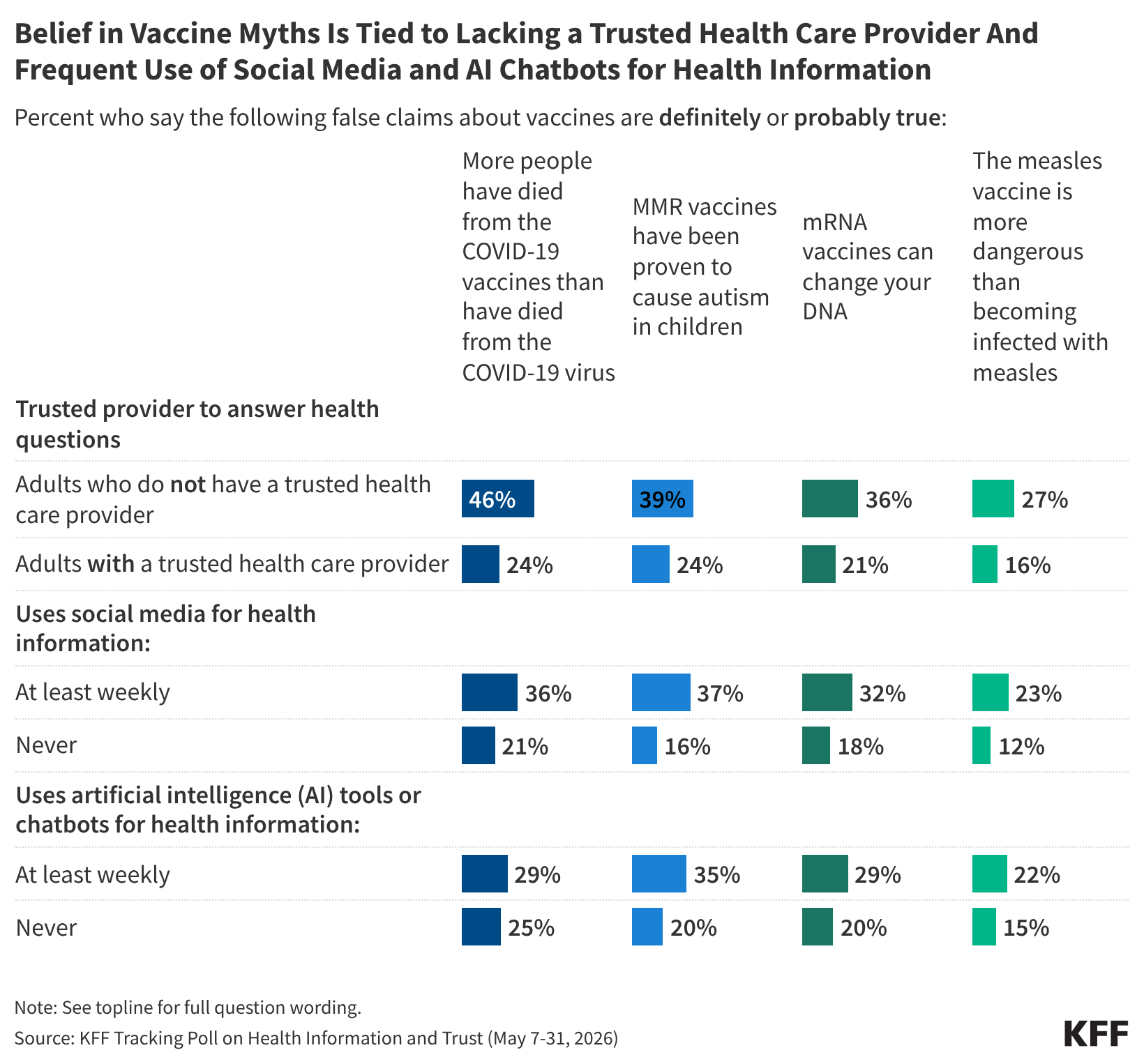
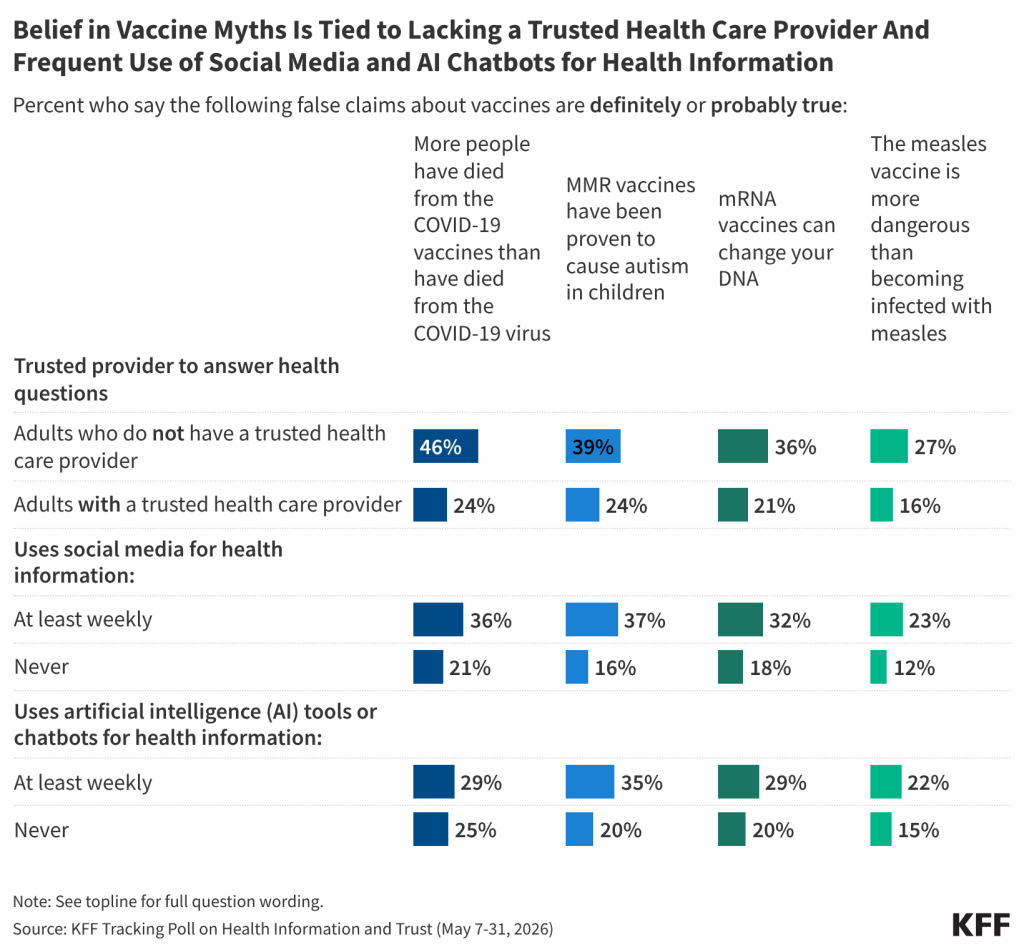
    People who don’t have a trusted health care provider are more likely than people with one to believe or lean toward believing several common myths about vaccines, a new KFF Tracking Poll on Health Information and Trust reveals. Similarly, people who use social media or artificial intelligence (AI) chatbots at least weekly for health information are more likely than those who don’t to endorse these false vaccine claims.

    One example: Among adults who say they do not have a doctor or other health provider they trust to answer questions about their health, about 4 in 10 (39%) incorrectly believe that it is either “definitely” or “probably true” that MMR vaccines have been proven to cause autism in children, compared to a quarter (24%) among those who say they have a trusted provider.

    Similarly, more than a third of people who report using social media (37%) or AI chatbots (35%) at least weekly for health information incorrectly say this myth is true, about twice the share among those who never use social media (16%) or AI (20%) for health information.

    The poll finds a similar pattern for most of the other vaccine myths tested for people without a trusted doctor as well as for people who frequently use social media or AI for health information. The differences remain significant even when controlling for other factors such as age, race and ethnicity, education, partisanship, and insurance status.
    Poll: People Without a Trusted Health Care Provider Are More Likely to Endorse Vaccine Myths, As Are Those Who Often Use Social Media or AI for Health Information插图

    Exposure to each of these false claims has been fairly steady in KFF polls over the past several years, though the share who report hearing the myth that mRNA vaccines can alter a person’s DNA dropped by 9 percentage points since April 2025 (from 45% to 36%). Exposure to the myth that measles vaccines are more dangerous than measles rose between 2024 and 2025, but has remained steady since then (29% now).

    Across the four false vaccines claims, far more people say the claims are “definitely false” than say they are “definitely true,” but at least half of the public is less certain what to believe, falling into the malleable middle and saying each of these claims are either “probably true” or “probably false.”

    While many parents who skip or delay recommended vaccines for their children express uncertainty over vaccine myths, they are also about twice as likely as parents who keep their children up to date on vaccines to believe or lean toward believing false claims about the measles and COVID-19 vaccines.

    The pattern is true for each of the four false claims: that MMR vaccines cause autism in children (57%  among those who delay or skip vaccines v. 30% among those who stay up to date), that more people died from COVID-19 vaccines than the virus itself (55% v. 29%), that mRNA vaccines alter DNA (52% v. 23%), and that measles vaccines are more dangerous than measles (43% v. 18%). This relationship remains significant even when controlling for factors like age, education, and partisanship.

    The poll also includes a new analysis that identifies patterns of belief across the four false claims and sorts them into a new belief typology. A small share (8%) are consistent or leaned myth believers (saying all four claims are either “probably” or “definitely true”) and just over half (55%) are consistent or leaned myth deniers (saying all four claims are either “probably” or “definitely false”). About 3 in 10 (31%) are in the mixed middle, providing a range of true and false answers and lacking certainty on at least half of the claims.

    Designed and analyzed by public opinion researchers at KFF, this survey was conducted May 7-31, 2026, online and by telephone among a nationally representative sample of 2,480 U.S. adults in English and in Spanish. The margin of sampling error is plus or minus three percentage points for the full sample. For results based on other subgroups, the margin of sampling error may be higher.

    Health Information and Trust,Public Opinion,Artificial Intelligence,Social Media,VaccinesArtificial Intelligence,Social Media,Vaccines#Poll #People #Trusted #Health #Care #Provider #Endorse #Vaccine #Myths #Social #Media #Health #Information1782815628

    Artificial Intelligence care Endorse health Information Media Myths People Poll Provider Social Social Media Trusted Vaccine vaccines
    admin
    • Website

    Related Posts

    Journalists Dig Into HHS’ Covid Injury List, ACA Sign-Ups, and Telehealth

    July 18, 2026

    KFF Tracker: U.S. Global Health Programs by Country and Region

    July 16, 2026

    Trump’s CDC Nominee Praises Vaccines, Without Vowing Independence From Kennedy

    July 16, 2026

    Leave A Reply Cancel Reply

    Don't Miss
    Fitness

    Journalists Dig Into HHS’ Covid Injury List, ACA Sign-Ups, and Telehealth

    By adminJuly 18, 20260

    Céline Gounder, KFF Health News’ editor-at-large for public health, discussed the Department of Health and…

    Pandemic Talks Consider Two Opposing Models for Pathogen Sharing

    July 17, 2026

    Unitaid’s Opaque Leadership Search Advances Amid Plunging Budgets, Calls for Reform

    July 17, 2026

    Landmark NHS approval of cancer drugs offers new hope for children and adults with rare blood cancers

    July 17, 2026
    Stay In Touch
    • Facebook
    • Twitter
    • Pinterest
    • Instagram
    • YouTube
    • Vimeo
    Our Picks

    Journalists Dig Into HHS’ Covid Injury List, ACA Sign-Ups, and Telehealth

    July 18, 2026

    Pandemic Talks Consider Two Opposing Models for Pathogen Sharing

    July 17, 2026

    Unitaid’s Opaque Leadership Search Advances Amid Plunging Budgets, Calls for Reform

    July 17, 2026

    Landmark NHS approval of cancer drugs offers new hope for children and adults with rare blood cancers

    July 17, 2026

    Subscribe to Updates

    Get the latest creative news from SmartMag about art & design.

    Demo
    About Us
    About Us

    Your source for the lifestyle news. This demo is crafted specifically to exhibit the use of the theme as a lifestyle site. Visit our main page for more demos.

    We're accepting new partnerships right now.

    Email Us: info@example.com
    Contact: +1-320-0123-451

    Our Picks

    Large Study of COVID Vaccine Side Effects in Sweden

    January 12, 2020

    Coronavirus latest: Japan’s Vaccination Rate Tops 75% As Cases Drop

    January 10, 2020

    J&J’s New Vaccines Leader Talks Covid-19 & Pipeline Plans

    January 8, 2020

    Journalists Dig Into HHS’ Covid Injury List, ACA Sign-Ups, and Telehealth

    July 18, 2026

    Pandemic Talks Consider Two Opposing Models for Pathogen Sharing

    July 17, 2026

    Unitaid’s Opaque Leadership Search Advances Amid Plunging Budgets, Calls for Reform

    July 17, 2026
    Facebook Twitter Instagram Pinterest
    • Home
    • Health
    • Nutrition
    • News
    © 2026 ThemeSphere. Designed by WPfastworld

    Type above and press Enter to search. Press Esc to cancel.